Renovation of Venice Biennale's Central Pavilion Complete
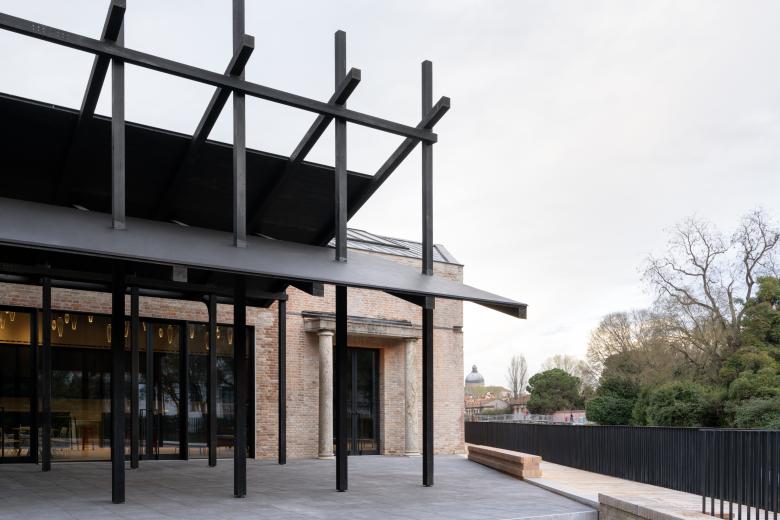
The renovation of the Central Pavilion at the Giardini della Biennale, closed since late 2024, has been completed and will reopen for the Biennale Arte 2026 in May. The project's architectural design was carried out by Labics and architect Fabio Fumagalli.
Visitors to the 2025 Venice Architecture Biennale most likely noticed that the International Architecture Exhibition curated by Carlo Ratti was dense, fitted as it was primarily inside the Corderie building at the Arsenale. That situation arose from the fact the Central Pavilion, usually a venue for the international art and architecture exhibitions, was closed for 16 months due to a €31 million renovation. In a statement, La Biennale di Venezia describes it as “one of the most complex projects in the program to renovate the Biennale infrastructures, both for the importance of the building and the particularly tight construction schedule.”
First built in 1895, what is now known as the Central Pavilion has been added to and renovated numerous times in the decades since, served as the Italian Pavilion for much of its the 20th century, and been eyed by famous architects—Carlo Scarpa and Louis Kahn among them—for grander schemes that did not come to light. The renovation carried out by Labics, the Roman practice of Maria Claudia Clemente and Francesco Isidori, and Fabio Fumagalli aims to restore the building's “order, hierarchy and spatial clarity,” while also “[rewriting] the entire architectural organism, redefining relationships, sequences and connections.”
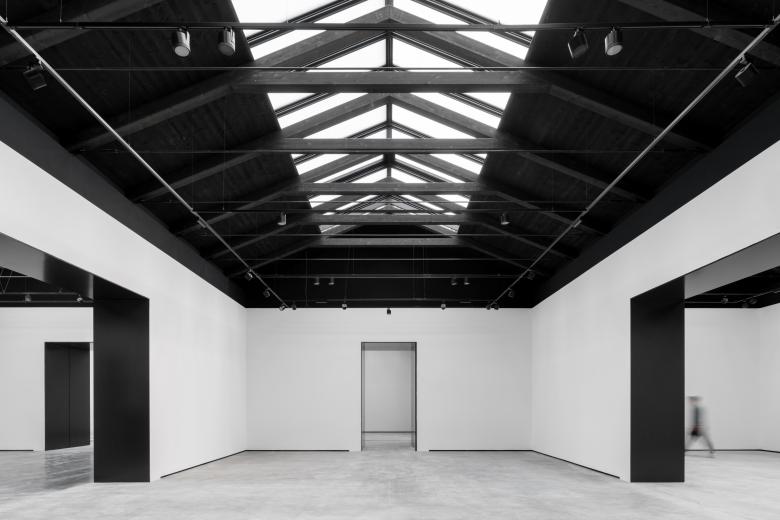
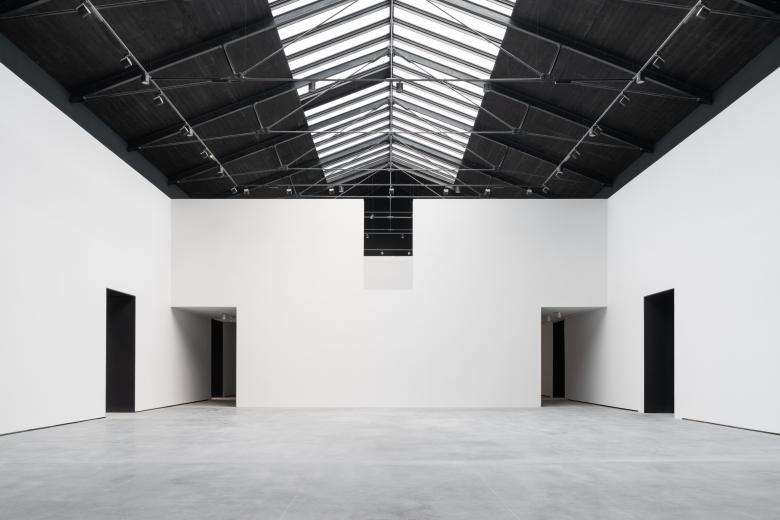
People familiar with the interior of the Central Pavilion from previous Biennales will notice one element missing in photographs of the completed renovation included here: ductwork. Though not present in every gallery, large round ducts bringing conditioned air to the skylit spaces was a common sight, an occasional distraction from the art on display. In the renovation, the exhibition spaces have become “neutral and flexible, veritable white boxes,” thanks to all of the technical systems being “integrated within the building envelope and hidden behind the new walls, leaving the spaces completely free.”
The exhibition spaces comprise 3,100 square meters (33,370 square feet) of the 5,450-m2 (58,665-sf) building, while 865 m2 (9,310 sf) are devoted to reconfigured support spaces that include the bookshop, educational and multipurpose spaces, the café, and restrooms.
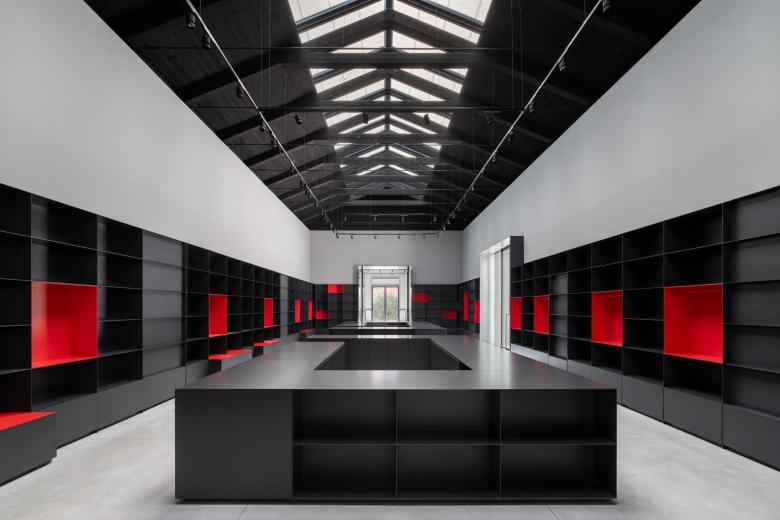
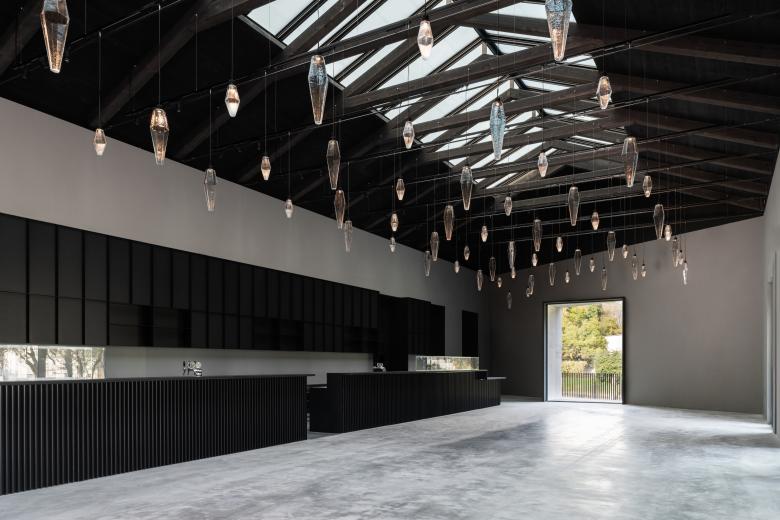
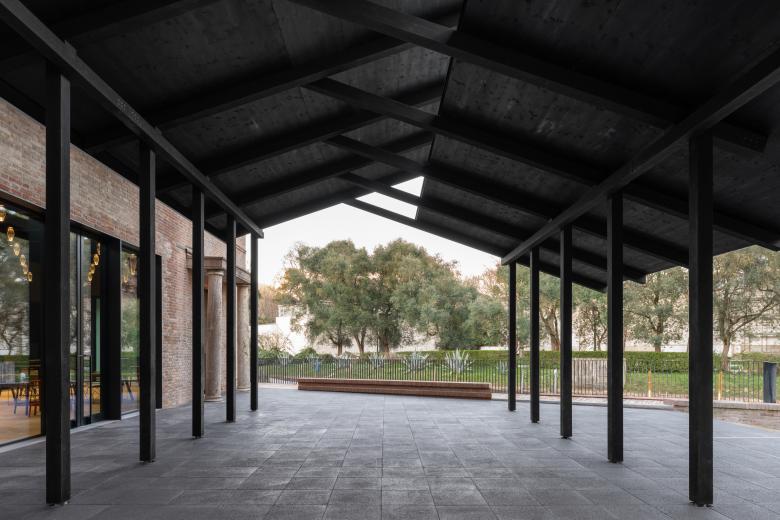
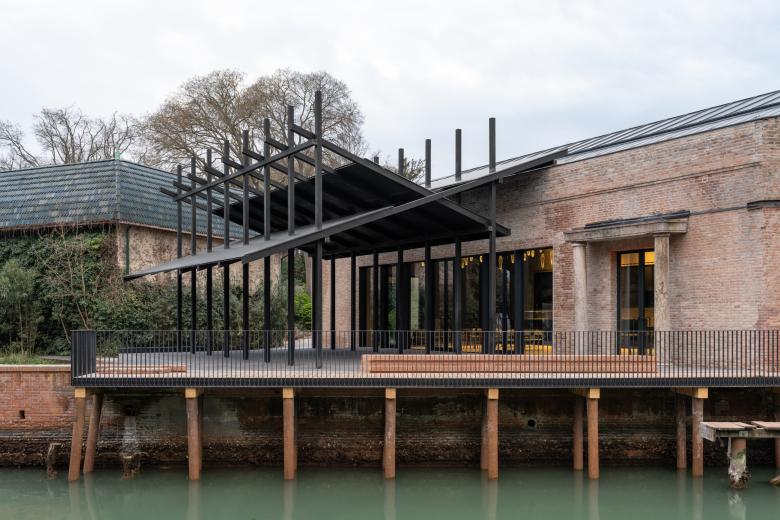
A minimal, “completely free” aesthetic extends to these support spaces, most notably the bookshop and café. Accessible from both the main entrance and the south facade, the renovated bookshop features black and red shelves at the perimeter and matching counters floating like islands in the middle of the rectilinear space that is, like the galleries, illuminated by a skylight. For the café, gone is artist Tobias Rehberger's chaotic, Golden Lion-winning creation from 2009, which felt a bit like eating inside a piece of Pop Art. In its place, Labics and Fumagalli have crafted yet another minimal space, with dark cabinets and counters and lights suspended beneath yet another skylight. An opening toward the southeast—present in earlier iterations of the Central Pavilion—leads to a shaded terrace along the canal.
The Central Pavilion renovation was made possible by public funding from the Italian Government, allocated by the Ministry of Culture as part of the National Plan for Complementary Investments (PNC) of the National Recovery and Resilience Plan (PNRR). The project is part of the Ministry of Culture’s “Great Cultural Heritage Attractors” program and forms part of a wider program to develop and enhance the activities of La Biennale di Venezia, which contemplates a series of interventions consisting of 22 works involving buildings and sites owned by the City of Venice, and located in the Giardini della Biennale, the Arsenale di Venezia, the Lido di Venezia, Forte Marghera and Parco Albanese (Bissuola).
The renovation was overseen by the offices of La Biennale di Venezia through its Special Projects department directed by architect Arianna Laurenzi with engineer Cristiano Frizzele, Head of the Technical and Logistics Services. The project was developed by the temporary association of professionals comprising BUROMILAN - Milan Ingegneria S.p.A (lead firm), Labics S.r.l. and architect Fabio Fumagalli for the architectural design, ia2 Studio Associato for MEP systems engineering and fire prevention, and geologist Francesco Aucone. Site supervision was entrusted to the engineer Massimiliano Milan. The open tender procedure for the construction of the works concluded in November 2024 with the award of the contract to Setten Genesio S.p.A.
Verwandte Artikel
-
AlMusalla at the Islamic Arts Biennale 2025
EAST Architecture Studio | 03.02.2025 -