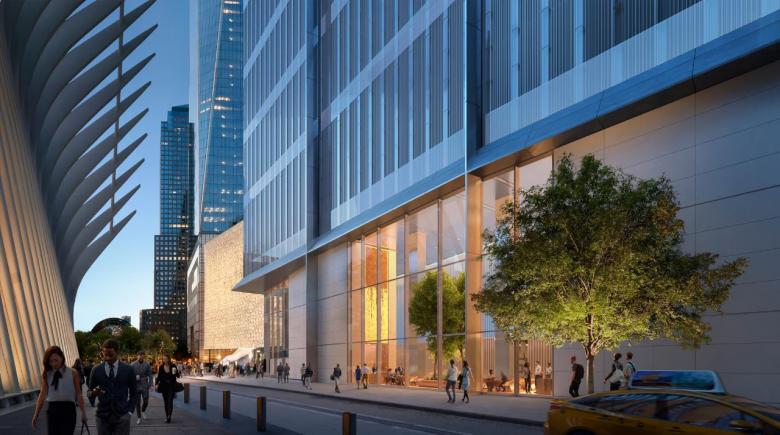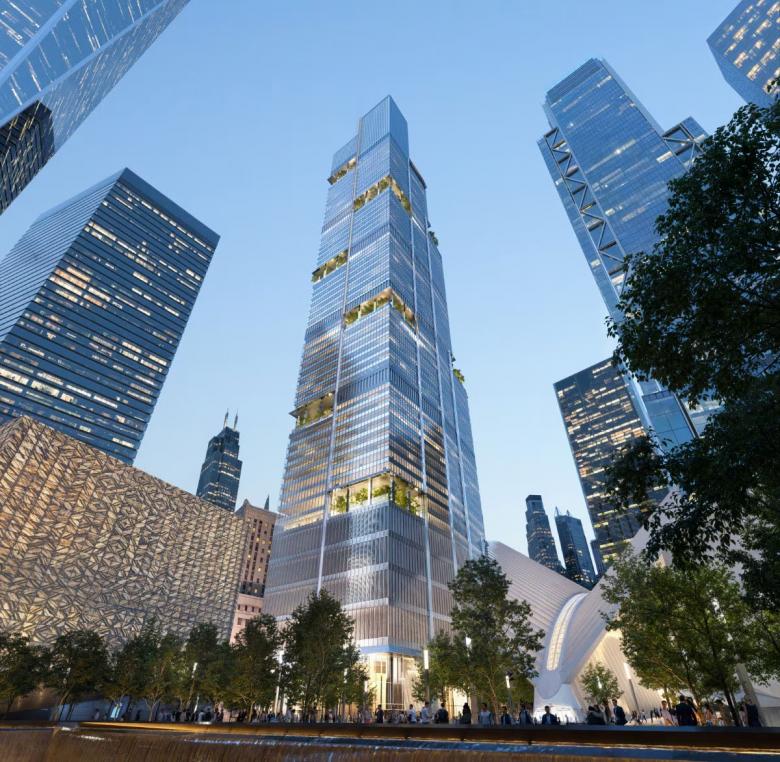
The last vacant commercial parcel at the World Trade Center site in Lower Manhattan will be filled by American Express, which announced that it will own and occupy 2 World Trade Center, a 55-story tower being designed by Foster + Partners.
Yesterday's announcement from American Express is good news for 200 Greenwich Street, the official address of 2 World Trade Center, which has been a big question mark on the 16-acre WTC site for years. Norman Foster was hired by Silverstein Properties, the developer of the site's commercial properties, to design 2WTC in 2006, the same year Fumihiko Maki and Richard Rogers were hired to design 4WTC and 3WTC, respectively. Whereas those towers opened in 2013 and 2018, respectively, construction on Foster's tower with its distinctive diamond-shaped apex never progressed beyond foundation work, given that Silverstein could not secure an anchor tenant. In 2015, Bjarke Ingels replaced Foster as architect, designing a stepped tower for 21st Century Fox Inc. and News Corp., but the following year the two Rupert Murdoch-owned companies pulled out of the deal, leaving the site in limbo. It would be another five years for any significant news on 2WTC, when in the fall of 2021 it was reported that Foster was working on a new design for the tower—tenant TBD.
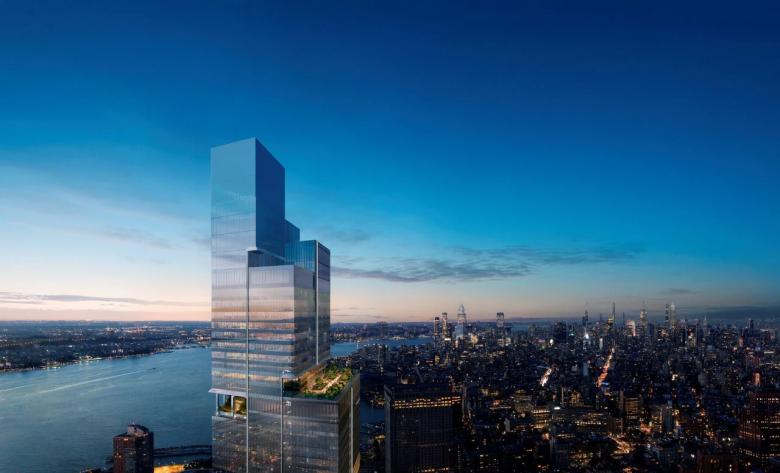
With Silverstein finally able to land an anchor tenant for 2WTC, construction is expected to restart this spring, with completion of the building targeting 2031—25 years after Foster was first hired. Foster + Partners will serve as design architect and Silverstein Properties as developer. American Express will own and be the sole occupant of the building, leasing it from the Port Authority of New York and New Jersey, which owns the land. The 55 office floors will total approximately 2 million square feet (186,000 m2), with the tower reaching a height of 1,226 feet (374 meters). When complete, AMEX will move approximately 10,000 employees from 200 Vesey Street—aka 3 World Financial Center in Battery Park City, directly west of the WTC site—which the company has occupied since 1986.
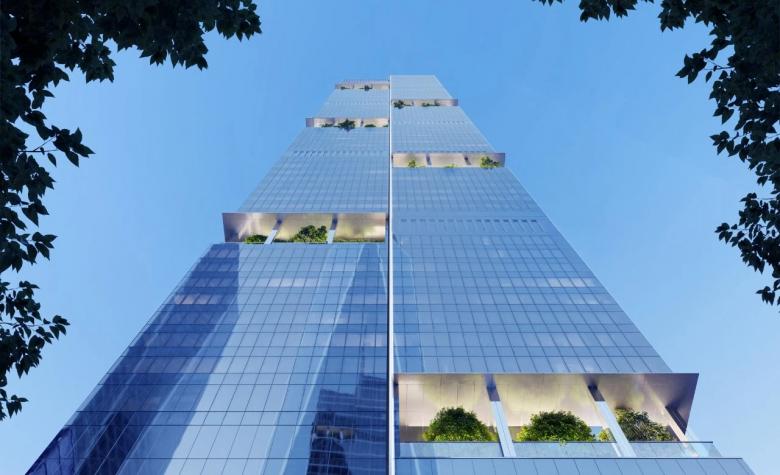
The renderings accompanying this week's announcement show a design that seems to blend certain aspects of Foster's initial design and Ingels' subsequent design. The verticality of the initial design is evident in the articulation of the facade, while the provision of terraces in Ingels' design can be found in the three terraces found at setbacks on the east side of the tower and in the six corner gardens on the west facade overlooking One World Trade Center and the 9/11 Memorial. These outdoor spaces are highlighted in Foster's statement accompanying the announcement: “The design of the American Express building is rooted in sustainability and well-being, to create a state-of-the-art environment that supports the company’s vision for the future. A network of landscaped terraces and gardens provides generous outdoor spaces and contact with nature in the pursuit of a healthier and more desirable working lifestyle.”