Venice Biennale: 14th International Architecture Exhibition
Venice, Italia
Fundamentalists and Other Arab Modernisms.
At a moment when the Arab world is in turmoil, it seems relevant to assess what remains of the pan-Arab project; a transnational political and cultural project, born in the early 20th century, coinciding with the birth of modernism in the region.
The seeds of that modernist project arrived mostly from the European colonial powers. These attempts at modernity started materializing with the early development of the young nation-states. It is important to note that the nation-state, and thus the notion of nationalism, arose in the region mainly as a consequence of colonialism.
But soon enough, the ideological bases of the national projects were losing their dynamic, giving way to other forms of economical and socio-political ideologies. This happened to coincide with the exhaustion of the modernist project in the Arab world, voiding it out from its initial agenda and bringing forward ostentatious images of a blindly imported and sometimes baseless modernity.
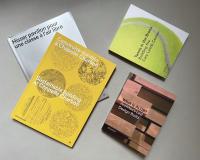
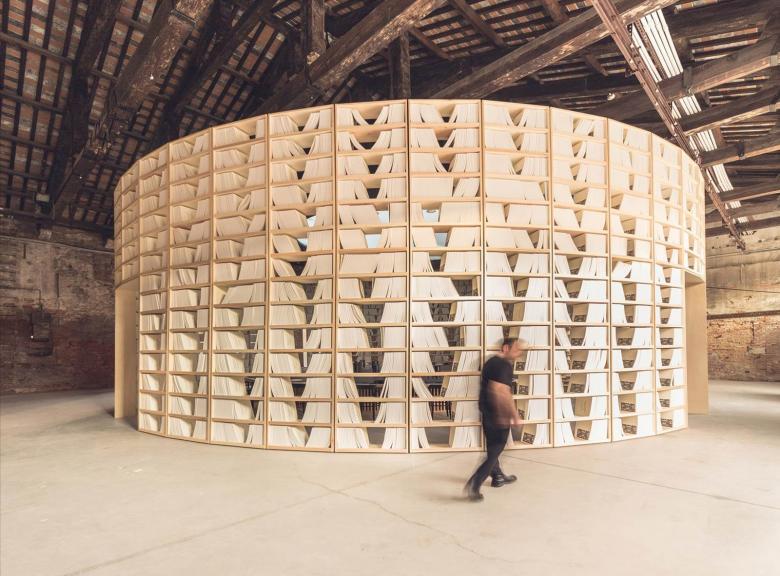
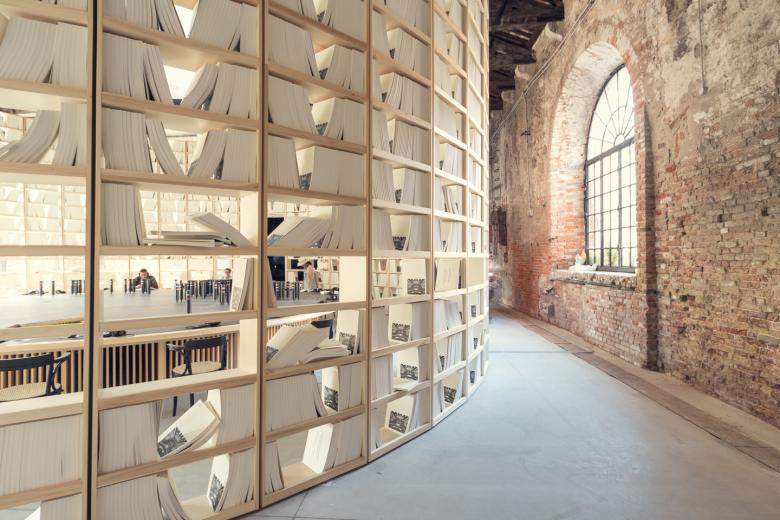
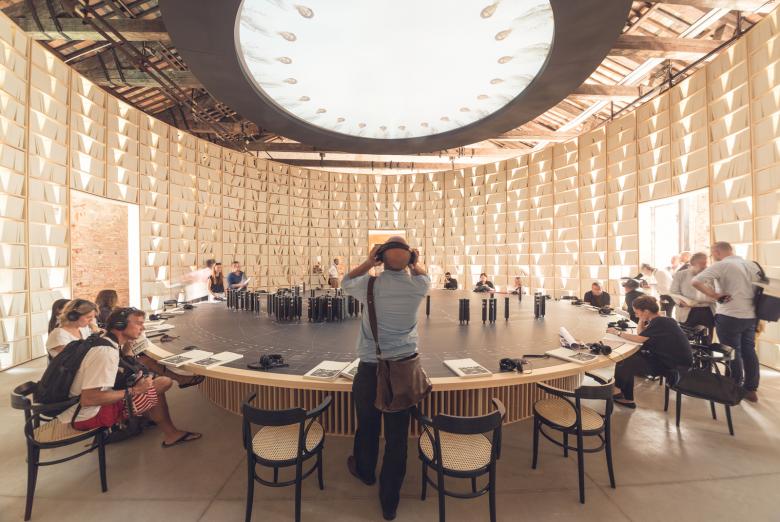
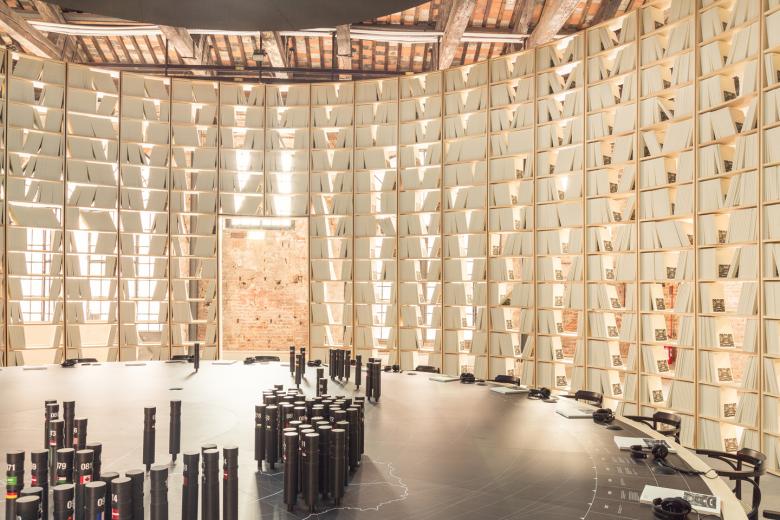
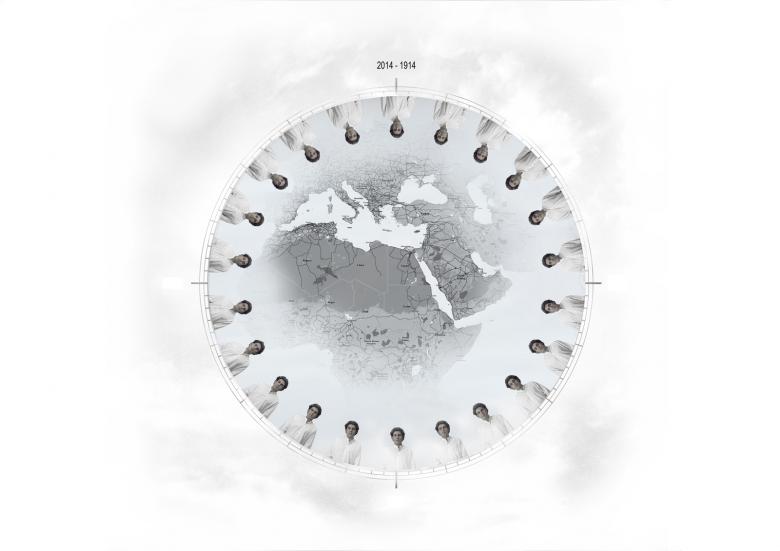
The exhibition consists of a circular library defining the peripheries of our spatial intervention and holding 40,000 copies of a book edited by the Arab Center for Architecture. The book introduces the archives of the center, promoting its objective to raise awareness about architecture and urbanism within civil society. It contains a subjective, non-exhaustive reading of the architectural legacy of the last hundred years across the Arab World, portrayed through the documentation of one hundred selected buildings.At the center of the room, a table of eight meters in diameter comprises a geographical map the Arab world on its surface. Each one of the hundred selected buildings is placed on its respective geographic location, and is represented by an identical pole branded with the flag of the architect’s nationality. Representing the buildings using identical symbols stems from our intention to prevent any qualitative architectural judgment. At the periphery of the table is a circular timeline depicting selected socio-political events in chronological succession from 1914 to 2014, linked to the geographical map by vectors traced on the table.
Above the table, an animated video is projected onto a circular ceiling, on which 22 clones of the same actor recite the national anthems of the 22 countries of the Arab league. Playing simultaneously and on a loop, these narrations symbolize, through an overwhelming cacophony of sounds, the chaos produced by the failure of the pan-Arab project and all forms of nationalist aspirations.
- Arquitectos
- Bernard Khoury / DW5
- Año
- 2014
- Estado del proyecto
- Construido