National Capital Planning Commission to Review Plans in March
Commission of Fine Arts Approves Trump's Ballroom
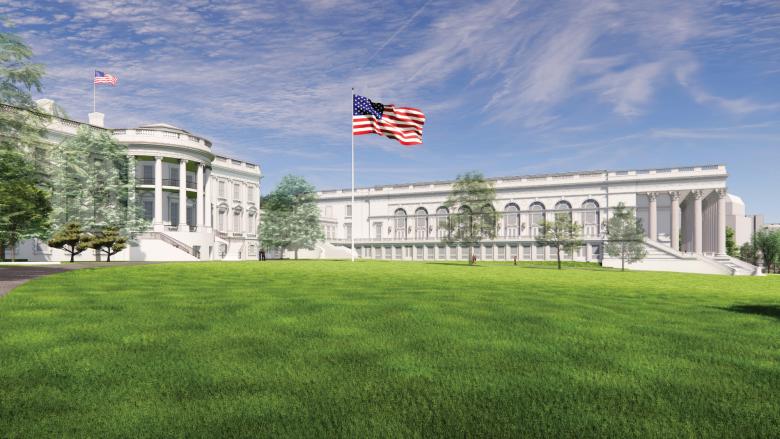
The seven members of the US Commission of Fine Arts (CFA)—all of whom were appointed by President Donald Trump in January—have approved plans for a $400 million ballroom to replace the White House's East Wing that was demolished last fall. Approval by the National Capital Planning Commission (NCPC) is next.
The timeline of events in the ongoing story of Trump's ballroom is anything but typical. Last October, just two months after renderings were revealed of a proposed $200 million ballroom designed by the DC firm of architect James C. McCrery, excavators laid waste to the East Wing of the White House—before plans were submitted to the CFA and NCPC, as is the norm, much less approved by them. The backwards procedure is evidence of Trump's move-fast-and-break-things behavior during his second term, emboldened by the Supreme Court's ruling that he enjoys absolute immunity for any acts conducted in his capacity as president.
The atypical process is aided further by packing the bodies that review the ballroom and other projects dear to the administration with Trump allies. After firing the remaining members of the CFA in November, Trump appointed their replacements, including McCrery, who was removed from the ballroom project in favor of Shalom Baranes but nevertheless recused himself from reviewing the ballroom. Still, with Trump's former receptionist, 26-year-old Chamberlain R. Harris, most recently appointed to the commission, the handpicked CFA unanimously approved the ballroom plans this week—regardless that 99 precent of the more than 2,000 messages submitted to the commission by US citizens ahead of the review were opposed to the project, described as “a fundamental miscarriage of democratic principles.”
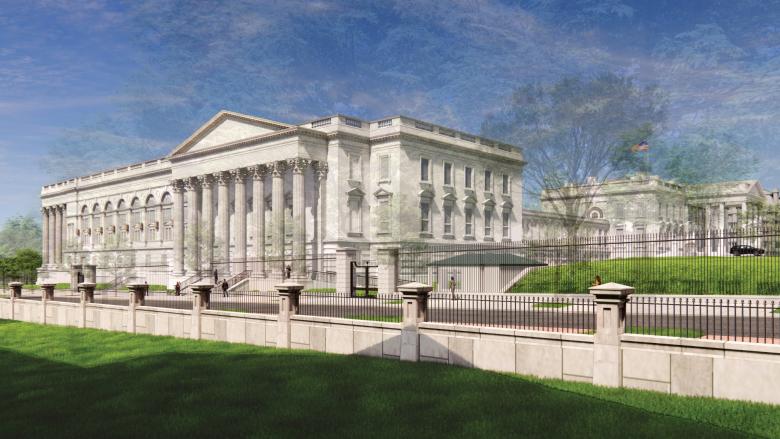
The remaining hurdle in the federal review of the ballroom, whose construction has been allowed to proceed by a judge despite a lawsuit filed by the National Trust for Historic Preservation (NTHP), is approval by the National Capital Planning Commission, which will meet on March 5. (During that scheduled meeting it will also review, among other things, the master plan for Washington Dulles International Airport, another one of the Trump administration's pet projects.) Shalom Baranes presented plans for what's being called the “East Wing Modernization Project” to the NCPC in January, and in the ensuing weeks his firm has tweaked the design and unveiled additional features, such as a garden next to the ballroom, as revealed in a February 11 submission posted to the NCPC website (PDF link).
Images in the submission packet primarily consist of renderings and photomontages that serve to illustrate how the proposed ballroom will not overshadow the White House when seen from certain vantage points, such as from Pennsylvania Avenue on the north and from The Ellipse on the south. As revealed in the January 8 presentation, the NCPC is concerned with the appearance of the White House from publicly accessible places—which are few, given the wide circumference of security around the White House and its grounds. And given that, like the CFA, Trump has packed the NCPC with loyalists (it is headed by Will Scharf, the White House staff secretary), the latter's approval of the ballroom plans in March is basically a foregone conclusion.
Belated federal approvals aside, a ruling is expected this month over whether construction can continue on the ballroom project. The ruling stems from the lawsuit filed by the NTHP in December and is expected to come just before the NCPC review. Yet, even if US District Court Judge Richard J. Leon rules against the Trump administration, appeals would likely bump the final decision “to the DC Circuit, for certain, and, maybe, perhaps even to the Supreme Court,” Leon said. “Who knows?” At root in the case is the argument by the Trump administration that approval of the project ahead of demolition was not needed because the project is privately funded, as well as assertions that replacing the security bunker in the basement of the East Wing requires construction to continue. When unveiled last year, the ballroom was budgeted at $200 million, but it quickly doubled to $400 million in the ensuing months.