Trump, "Please!"
Judge Halts Construction of White House Ballroom Ahead of NCPC Approval
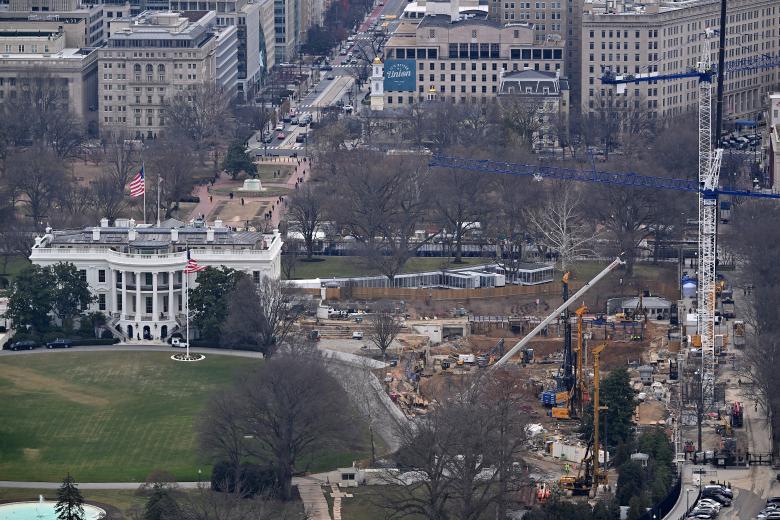
On Tuesday, March 31, US District Court Judge Richard J. Leon ruled that construction of President Donald Trump's ballroom at the White House needs to stop, since it lacks the proper approvals from Congress. The ruling came a couple days ahead of the National Capital Planning Commission's (NCPC) scheduled vote on the project.
During his second term as president, Donald Trump has favored an approach that runs counter to established norms and has incorporated techniques described as “flooding the zone” and “moving fast and breaking things.” Every day of every week brings onslaughts of new and often controversial statements, actions, and policies that the free press and public at large can barely digest, much less make sense of. And with a Republican-led Congress giving Trump free reign on everything from a world-shattering war down to a relatively inconsequential ballroom, the only recourse for countering the administration has been the courts.
But the courts move slowly compared to the Trump administration. Most relevant here is how it bulldozed the East Wing of the White House last October before a lawsuit could even be filed. One was eventually filed by the National Trust for Historic Preservation in December, when foundation work for the ballroom was underway, but Richard J. Leon, Senior Judge of the United States District Court for the District of Columbia, refused to halt construction then. Ditto in February, at the time of a second filing by the National Trust. Nevertheless, Leon gave the plaintiff advice on amending the lawsuit and promised to consider it "expeditiously" if its arguments focused on the president's power to make changes to the White House.
Then this week, just two days before the NCPC's expected approval—the last review needed for the project—Leon followed through on his promise and ruled in favor of the National Trust, contending that the president does not have the authority to make such changes to the White House without Congress's approval and therefore construction of the ballroom needs to stop. Leon spelled out his decision in a 35-page ruling that includes 19 exclamation marks and four instances of the phrase “Please!” in response to the defendants' arguments—it is an occasionally humorous document that is also worth reading for the way it makes the relationship between law and architecture explicit.
In one instance, Leon takes issue with the defendants' reading of the United States Code 105(d), “Assistance and Services for the President,” which says the president is responsible for “the care, maintenance, repair, alteration, refurnishing, improvement, air-conditioning, heating, and lighting (including electric power and fixtures) of the Executive Residence at the White House.” Trump's lawyers contended that “alteration” and “improvement” were “capacious” terms that permitted the president to “modify” the White House and building the ballroom; to which Leon responded: “A brazen interpretation, indeed!” For Leon, the context of the two terms—alongside “maintenance,” “air-conditioning,” “heating,” and other terms—narrows their meanings, pointing to minor alterations and improvements, not tearing down and erecting a new wing.
Although Leon ripped these and other holes in Trump's legal defense, he concluded his ruling with good news for the administration: “It is not too late for Congress to authorize the continued construction of the ballroom project. The President may at any time go to Congress to obtain express authority to construct a ballroom and to do so with private funds.” Yet, instead of exploring this as an option, Trump focused on Leon's willingness to “exclude construction necessary to ensure the safety and security of the White House from the scope of the injunction” and told reporters that the $400 million project is a matter of presidential security: “We have a drone-proof roof … air-handling systems … biodefense all over … secure telecommunications and communications all over … major medical facilities. We have all of these things … [so] I am allowed to continue building as necessary.” In regard to Leon's ruling that Congressional approval is required for the project to proceed, Trump said, “He’s so wrong.”