Between Tradition and New Beginnings
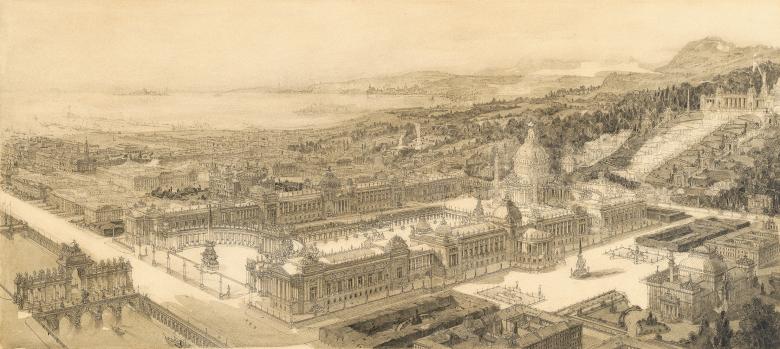
For the first time in more than sixty years, Otto Wagner's work is being exhibited in Germany. The drawings by the architect and his colleagues, some of whom are well-known, bear witness to the great leap from historicism to modernism at the turn of the last century.
He was the only Viennese architect of his generation to bridge the gap between historicism and “modern architecture,” to which he had already devoted a highly acclaimed paper in 1896. Otto Wagner (1841–1918) was not only an extraordinary architect and architectural theorist, but also a talented draftsman and an influential teacher (at the Vienna Academy of Fine Arts) for the next generation of architects. His office employed Josef Hoffmann, Joseph Maria Olbrich, and Josef (Jože) Plečnik, among others who—before making their mark in Vienna, Darmstadt, Prague, and Ljubljana—worked in Wagner's studio, developing his designs and visualizing them in exquisite drawings.
Drawing was the most important medium for Otto Wagner to express his architectural ideas. With great artistic effort and the help of talented colleagues, he had representative illustrations produced that not only contained technical and factual information, but also aimed to impress clients and a wider audience with their atmospheric added value. Wagner himself usually sketched in pencil, leaving the final presentation of projects to one of the up to 70 employees in his studio. In the exhibition dedicated to him at the Tchoban Foundation – Museum for Architectural Drawing (in collaboration with the Wien Museum), one of Wagner's hand-drawn Allegorie der Architektur ("Allegories of Architecture," 1892) can be seen as a female figure crowned with laurels, whose frame inscriptions provide insight into the parameters that were important to him: idealism, fatherland, religion, majesty fantasy, knowledge, prosperity, zeitgeist, and realism.
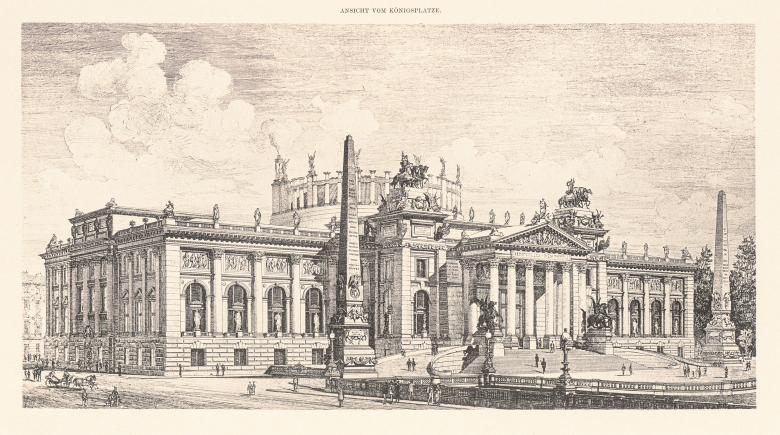
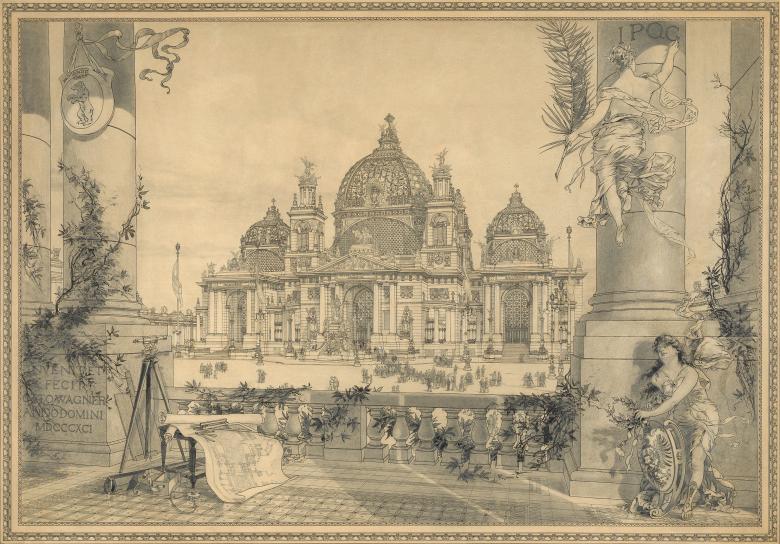
The exhibition in Berlin is divided into six chapters. Following the introduction (“Building through drawing”), the section “On the way to a style of the future” displays Wagner's early designs, in which he gradually moved away from the historicism that dominated at the time and toward a functional “style of the future.” The competition entry for the Reichstag building in Berlin (1882), with the semicircular shape of the chamber visible from the outside, was a turning point for Wagner, who had studied in Berlin, toward architectural authenticity with a “logical interlocking of form and function,” as the exhibition catalog puts it. He went one step further with his study for Berlin Cathedral (1890/91), for which Wagner had already submitted a competition design (unsuccessfully) in 1867. New constructions and materials—such as the openwork iron dome crowning the monumental building—were to shape his architectural works from then on, most of which were drawn by Rudolf Bernt at the time.
From the third chapter (“Architecture of acceleration”) onwards, the exhibition focuses mainly on Vienna, which was one of the fastest-growing cities in Europe at the end of the 19th century and therefore needed an efficient means of mass transit. In 1894, Wagner was commissioned to design the city railway—the largest project of his career, comprising 36 station buildings, 42 viaducts, 78 bridges, and 15 tunnels and galleries. The Tchoban Foundation has numerous studies and elaborate presentation drawings for functional stops and city railway bridges, some of which can be attributed to specific designers (in addition to Olbrich and Plečnik, these include Marcel Kammerer, Otto Schönthal, and Hubert Gessner).
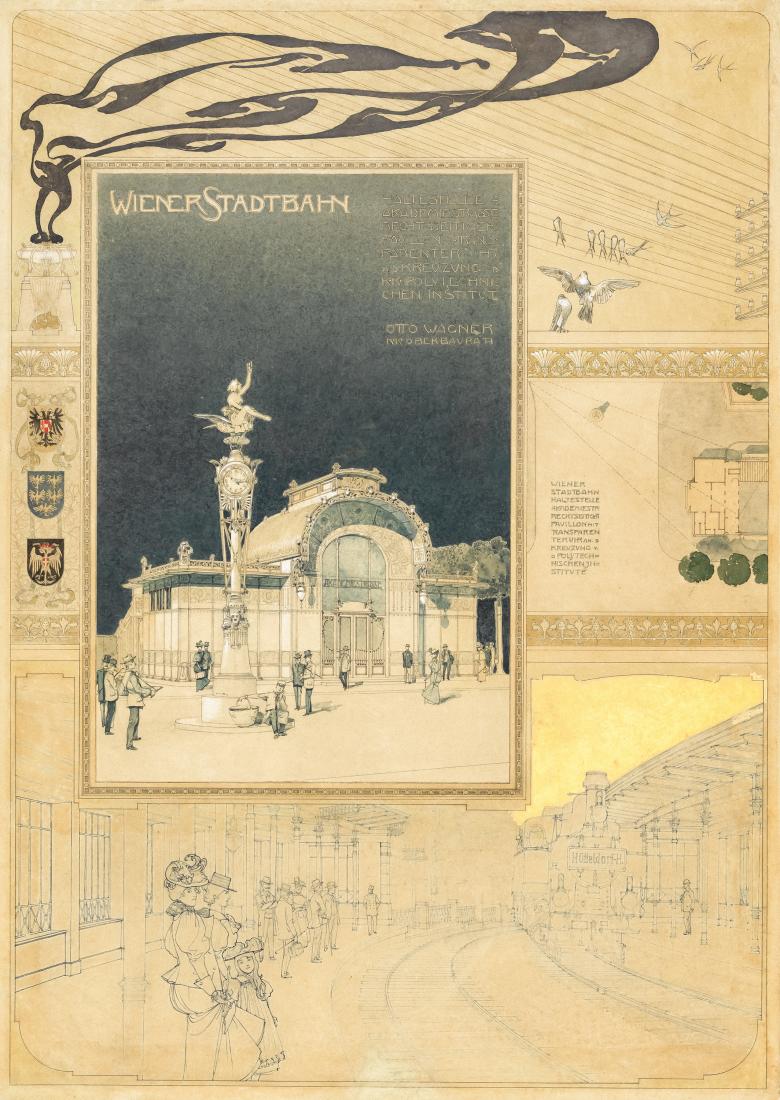
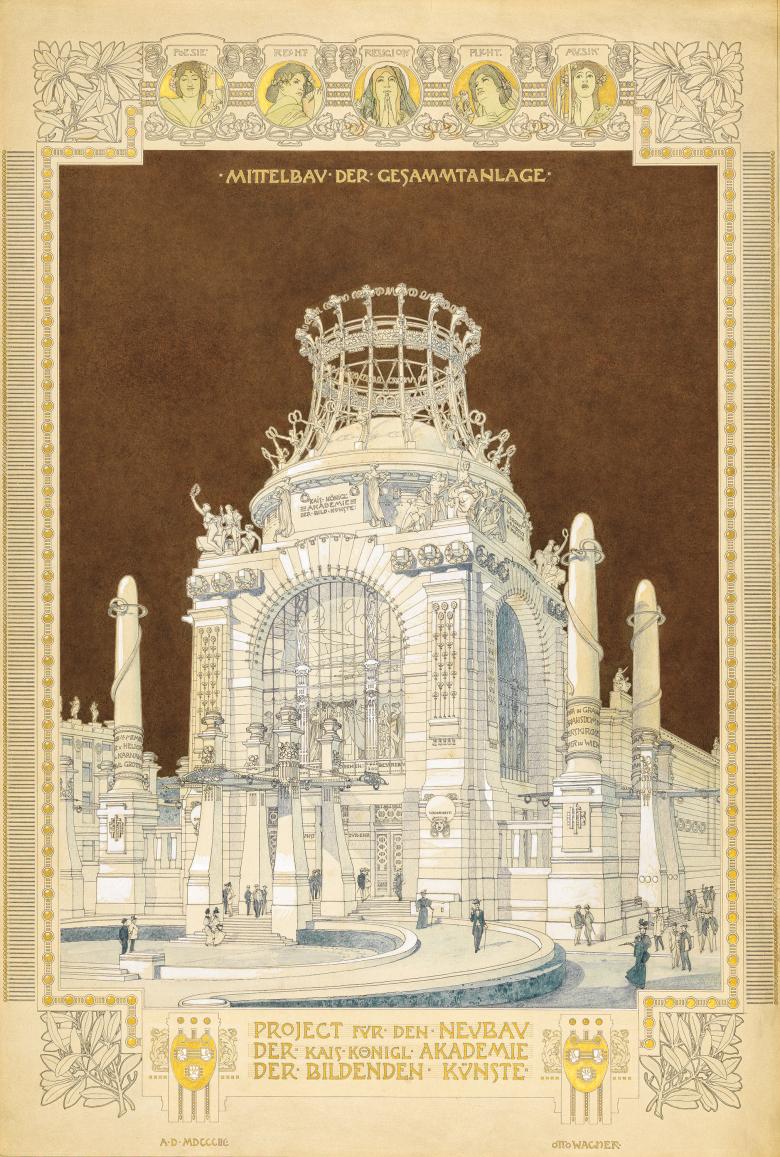
Another turning point—this time in Viennese art history—was marked in 1897 by the founding of the Vienna Secession, to which the fourth chapter, “Secession!,” is devoted. The Secession, which was influenced from the outset by Wagner's colleagues Hoffmann and Olbrich—the creator of the artists' association's “built manifesto” (1897/98)—was used by the actual “founding father” to exhibit ambitious projects, often without a specific planning commission. The colored sheets with allegorical Art Nouveau frames—for example, of a parish church in Währing (illustrators: Karl Ederer, Alois Ludwig, 1898) and for a new building for the Academy of Fine Arts as a veritable art quarter with a Hall of Honour in front (Karl Ederer, Emil Hoppe, 1898), as well as the studies for the expansion of the Wiener Hofburg (Franz Matouschek, 1898) and for a modern art gallery (1899), also in color and exhibited here for the first time—are sure to make the heart of any lover of artistically ambitious architectural drawings beat faster.
No less impressive are the sheets from two of Wagner's major works: the Postsparkasse (Postal Savings Bank) on Ringstraße (Otto Schönthal, 1903) and Church of Saint Leopold at Steinhof (competition drawings by Marcel Kammerer, 1902/03; monochrome drawings of the revised design by Otto Schönthal and Karl Ederer, 1903/04). They adorn the chapter “Monuments of modernism,” which however focuses on the competition designs for the City Museum on Karlsplatz (Emil Hoppe, 1901/02) and for a “major project” (Otto Schönthal, 1907; and with Karl Ederer, 1903), with which Otto Wagner unsuccessfully attempted to erect another monumental building committed to modern architecture in the vicinity of Karlskirche Church with the City Museum.
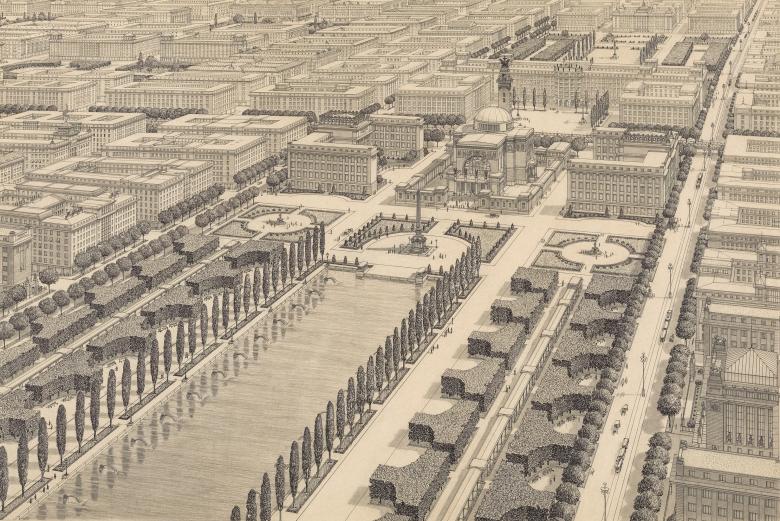
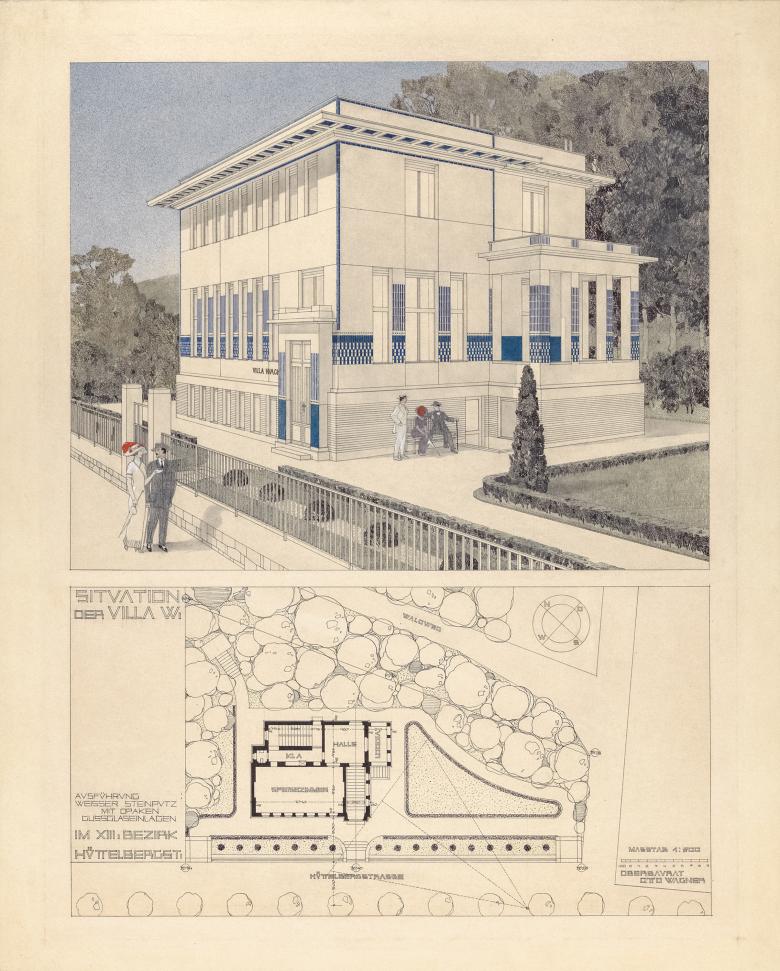
The final chapter is devoted to “The limitless metropolis,” on which Wagner published a study in 1911 that envisioned “mechanical” urban planning with straight streets and uniformly designed apartment buildings. As impressive as a bird's-eye view of the “Ideal Design of Vienna's 22nd District” (Otto Schönthal, 1911) may be, and as much as Wagner is rightly appreciated today as an architect of individual, even monumental buildings, one must be relieved—as was later the case with Le Corbusier—that he was not successful as an urban planner. On the other hand, he was able to show off all his skills in the second Villa Wagner, a cubic, almost unadorned building with a flat roof that would have done Adolf Loos proud. It is a pity that no interior perspective of this building—as with most of the other buildings selected for the exhibition—is shown; thus, it is left to the viewer's imagination to picture the spatial atmosphere behind the almost clinical facades.
Otto Wagner's great achievement was to have “stripped away the historical style.” His legacy lives on, of course, in his buildings, but no less so in the drawings created by him and his studio colleagues. We owe a debt of gratitude to the Tchoban Foundation and the Wien Museum for making these masterpieces accessible in Germany for the first time in over sixty years and in Berlin for the first time ever. No lover of architectural drawings should miss this opportunity.
This review was first published as “Zwischen Tradition und Aufbruch” on Austria-Architects. English translation edited by John Hill.
Related articles
-
-
-
Spaces for Cars – And for People
Kennedy & Violich Architecture, Ltd. (KVA) | 02.03.2026 -