The Van Nelle Factory and the Ideal of New Building
Light, Air, Modernity
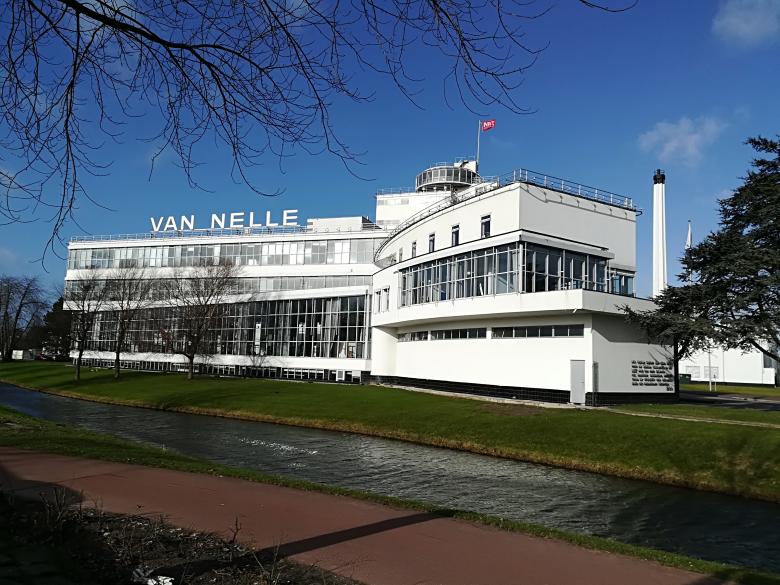
The Van Nelle Factory in Rotterdam is a masterpiece of modern architecture. As a successful symbiosis of function and aesthetics, it remains a model for students from all over the world. Cornelia Ganitta recently visited the complex, which now serves as a hub for creative industries.
“The ultimate goal of all art is the building!” With this programmatic statement, Walter Gropius opened the Bauhaus Manifesto in 1919. The statement marks a central idea of Modernism: architecture was to become the unifying framework for all the arts. Painting, sculpture, and design were to subordinate themselves to this overarching goal—architecture as a total work of art.
Two buildings exemplify this approach. One is the Bauhaus Dessau (1925/26), designed by Gropius, and the other is the Van Nelle Factory in Rotterdam, built between 1925 and 1931 and later dubbed the “Cathedral of New Building.” Both structures are now part of the UNESCO World Heritage List. Both rely on concrete, steel, and expansive glass surfaces. And both deliberately refrain from embellishing beauty with decorative elements. It is precisely in this radical reduction where their power lies: they demonstrate how function and aesthetic clarity can combine into a compelling architectural unity in the spirit of the guiding principle “form follows function.”
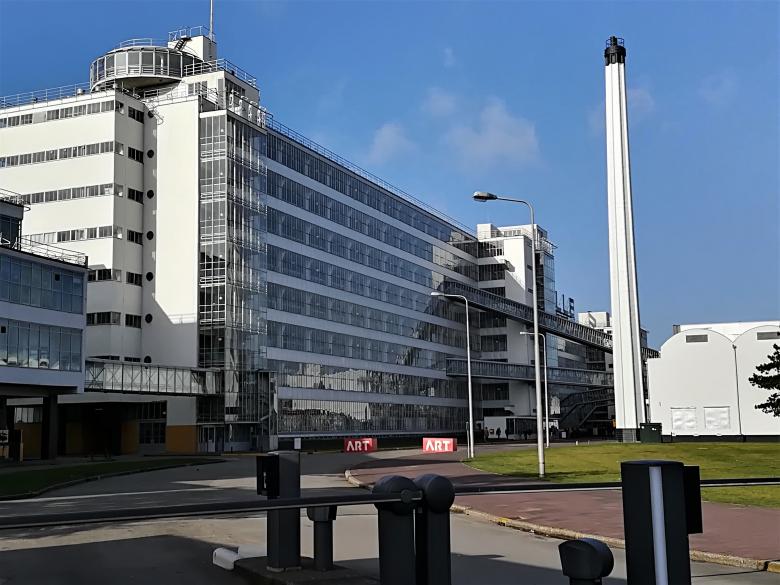
Much like Gropius, the entrepreneur Cees van der Leeuw also pursued a vision. As one of the directors of the Van Nelle company—and personally acquainted with the founder of the Bauhaus—he wanted to create a building that corresponded to the “new human” of the modern era. Light, air, and space was the credo of New Building. For a factory, this meant a radical departure from the dark, soot-blackened backyards of the industrial era, and toward a bright, transparent, and healthy work environment designed to make work not only more efficient but also more pleasant.
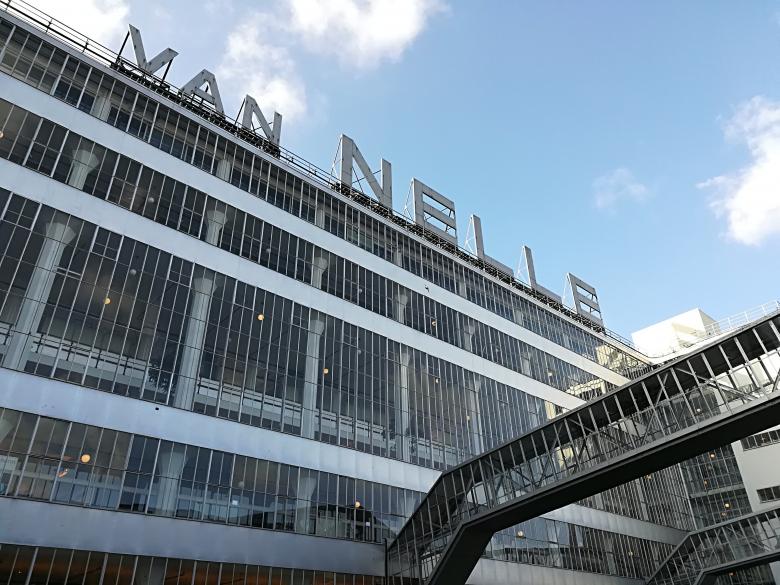
Inspiration came from the “Daylight Factory” in America, based on whose principles Van der Leeuw had the new Van Nelle factory designed. The architect in charge was Leendert van der Vlugt of the firm Brinkman & Van der Vlugt, who later also oversaw the construction of the directors’ villas at Museum Park in Rotterdam. He was assisted by industrial designer Willem Hendrik Gispen (who provided the furniture and lamps) and Mart Stam. Between 1926 and 1928, the then 27-year-old created the design drawings. Stam had already established contacts with the Russian avant-garde in Berlin. During his time at Brinkman & Van der Vlugt, he also organized an architectural tour of the Netherlands for the artist El Lissitzky, during which they visited representatives of the De Stijl movement such as Jacobus Johannes Pieter Oud, Gerrit Rietveld, and Cornelis van Eesteren. One result of this acquaintance was the brightly illuminated company logo on the factory roof, which stems from Mart Stam’s fascination with Russian Constructivism.

Yet this neon sign was hardly necessary to draw attention to the company. Even today, according to surveys, around 90 percent of the Dutch are familiar with the name Van Nelle, although production has long since ceased. What began in 1782 as a small grocery store developed over the centuries into a globally active manufacturer of coffee, tea, and tobacco with up to 2,000 employees.
When the old factory at Leuvehaven was bursting at the seams, the decision was made to build a new facility outside the city, near a large canal, adjacent to the Paris-Amsterdam railway line, which met the logistical requirements. However, the construction site presented the engineers with significant challenges. The marshy subsoil first had to be stabilized. To this end, thousands of reinforced concrete piles, each more than twenty meters long, were cast on site and driven into the ground using a Thomson steam pile driver imported from the United States.
The building’s structural framework—whose front and main facades resemble the bow of a large ship—was also unusual for Europe at the time. Mushroom-shaped concrete columns form the skeleton of the industrial structure, enabling large, column-free spaces without additional crossbeams. The production hall, only 17 meters wide, is flanked on both sides by glass curtain walls that ensure maximum natural light. Apart from the round, fully glazed tea house on the roof, the entire complex follows a strict geometry of clean lines, entirely in the spirit of the New Building movement.

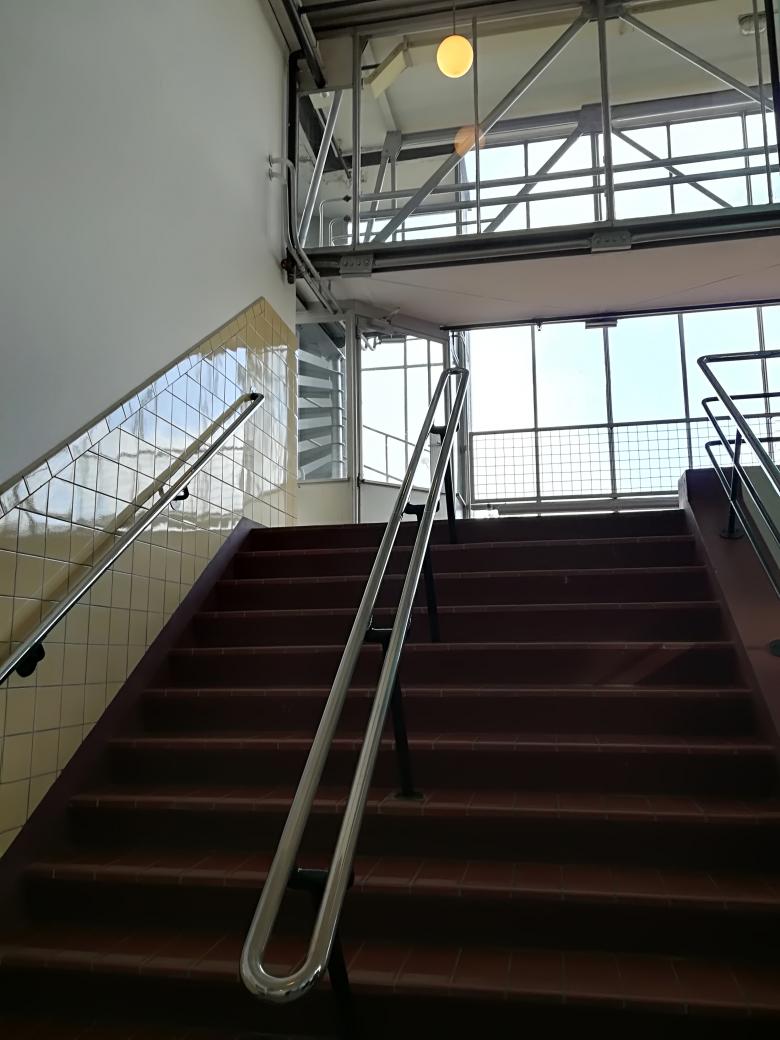
The factory was not only architecturally modern but also organizationally so. Hygiene, order, and efficiency—based on American work methods—played a central role. Shower rooms and drinking fountains, which were delivered with the tobacco shipment from the US, were just as much a part of the facilities as clear, straight pathways designed to achieve maximum efficiency. Stairwells were strictly segregated by gender, as were the two staff cafeterias—one for men and one for women—to prevent any distracting flirtations. The administration building also featured a gallery from which visitors could look down on the open-plan office where the typists worked. A practical side effect: Not only did guests observe the goings-on, management also kept an eye on their employees from here.
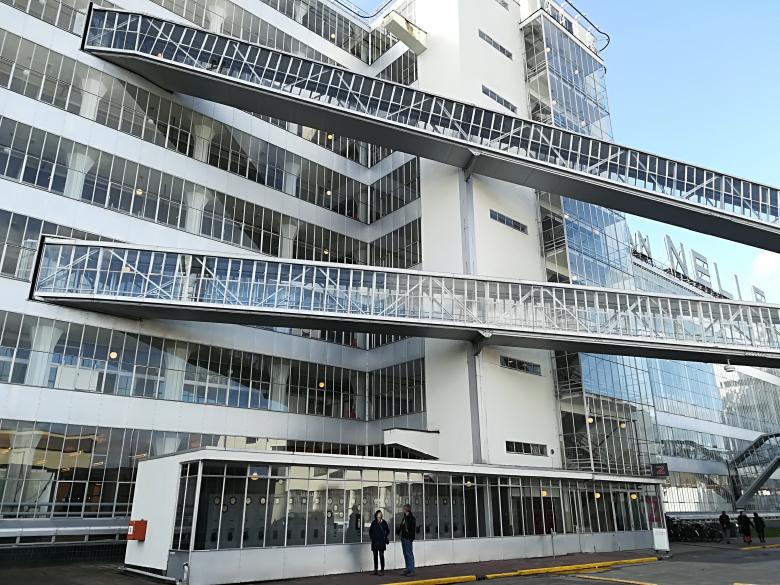
The curved administrative wing also served a strategic function. From here, the directors of the three product lines—tobacco, coffee, and tea—could monitor both the access road and the distinctive transport bridges connecting production and shipping. These bridges also served as a kind of testing laboratory where quality control inspectors checked the products. This allowed the coffee tester to actually perceive the aromas of his samples only here, far away from the intense smell of tobacco.
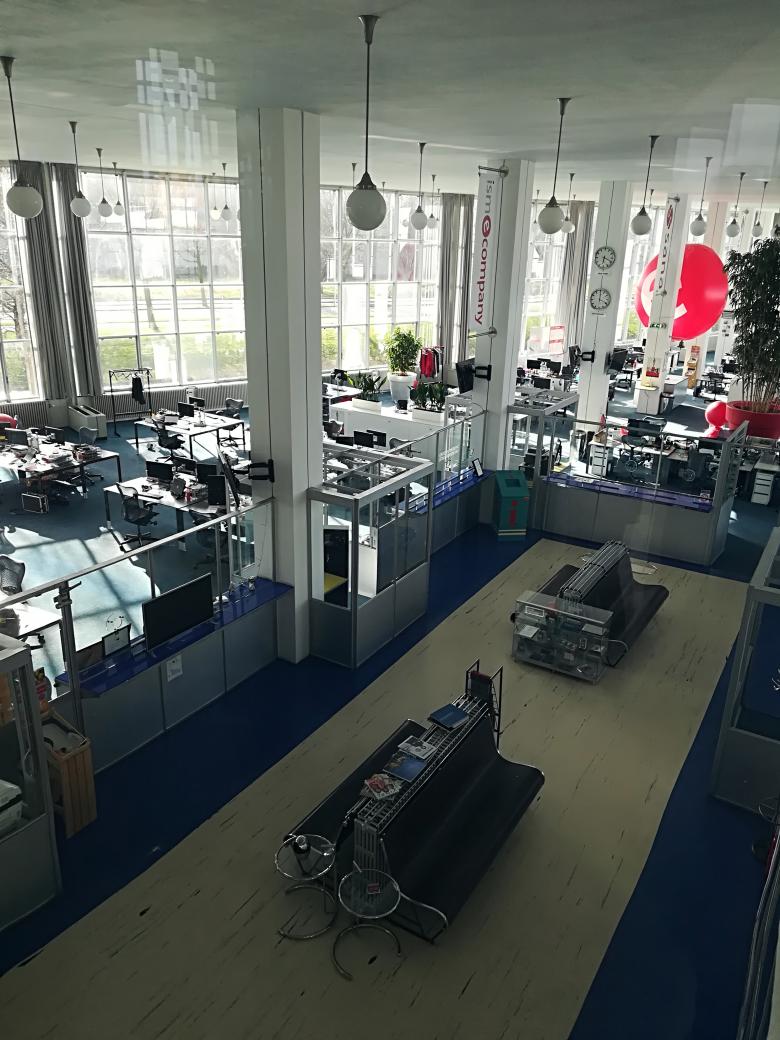
The factory remained in operation until 1995. After that, the question of the future of the 60,000-square-meter site lingered for a long time. Following a comprehensive renovation in the late 1990s, the complex evolved into a hub for creative industries. Today, the facility houses startups, design studios, and advertising agencies, as well as event spaces. Art Rotterdam was also held here until it moved last year.
The complex has been listed since 1986—fortunately, one might add. For without this protection, one of the most significant architectural symbols of industrial progress might have been lost and would no longer serve as a model for architecture students from around the world. Shortly before its completion in 1931, the architect Le Corbusier praised the complex as “the most beautiful sight of the modern age.” A judgment that has lost little of its persuasiveness to this day.