'Memoryscapes' at Louisiana Museum of Modern Art
Composed Landscapes of Memory and Production
On a recent trip to Denmark, Eduard Kögel ventured to Humlebæk to see Memoryscapes, the second exhibition in the Louisiana Museum of Modern Art’s “Architecture Connecting” series, on view at the museum until May 17, 2026.
The museum’s two curators, Mette Marie Kallehauge and Kjeld Kjeldsen, invited two architectural practices for Memoryscapes that are, on the one hand, inspired by approaches outside the discipline of architecture and, on the other, work through the integration of other scholarly fields. With this exhibition, the curators place cultural geography at the center of attention and deliberately expand the perspective beyond the narrow confines of conventional architectural practice.
The two invited offices are Atelier Tsuyoshi Tane Architects (ATTA), led by the Japanese architect Tsuyoshi Tane, and DnA_Design and Architecture, headed by the Chinese architect Xu Tiantian. Although ATTA is based in Paris, it works predominantly in Japan, while DnA_Design and Architecture is headquartered in Beijing and is primarily active in rural China.
Both practices, through different approaches, investigate how time, history, and narratives are perceived and remembered within local contexts. In today’s highly technologized Western world, time is largely understood as a mechanical quantity, moving relentlessly and uniformly from past to future. In premodern societies, by contrast, the life cycle played a fundamental role. Both offices draw on this more subjective understanding of time and explore how new points of reference can emerge from local potentials.
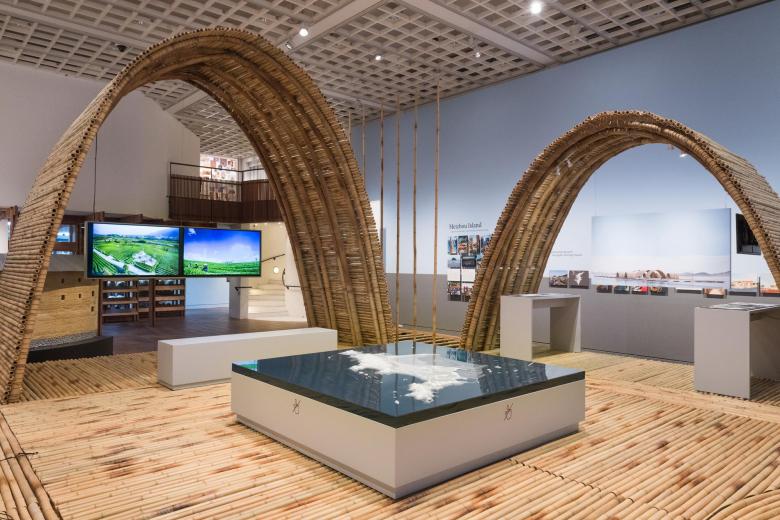
Xu Tiantian describes her method as Architectural Acupuncture, through which small, precise interventions activate and render usable existing potentials. Alongside the revitalization of traditions, this approach also addresses the adaptation of production in rural regions—an effort that, in turn, has a direct impact on the self-esteem and social cohesion of local communities. In the exhibition, Xu presents several projects, including works on Meizhou Island in Fuzhou Province: among them an Offshore Cooperative on a bamboo raft—partially shown at full scale (1:1)—and a new Seaweed Ecology Center. Both projects are aimed at improving the living conditions of fishing families.
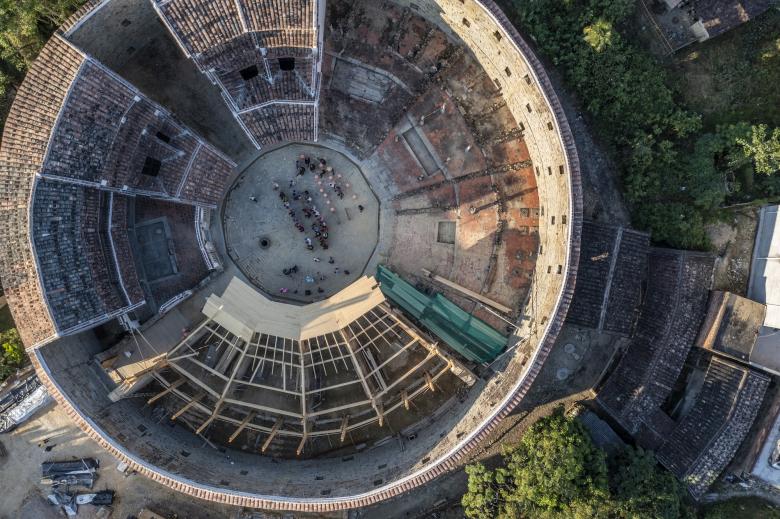
A second group of works focuses on the renovation of ruins of former tulou structures in Fuzhou Province. These buildings are characterized by massive rammed-earth walls and had already fallen out of use years ago. Originally conceived as fortified villages by the Hakka people, these monumental circular structures are today often abandoned. Due to their dilapidated condition, they are not protected as historical monuments and can therefore be adapted for new communal purposes.
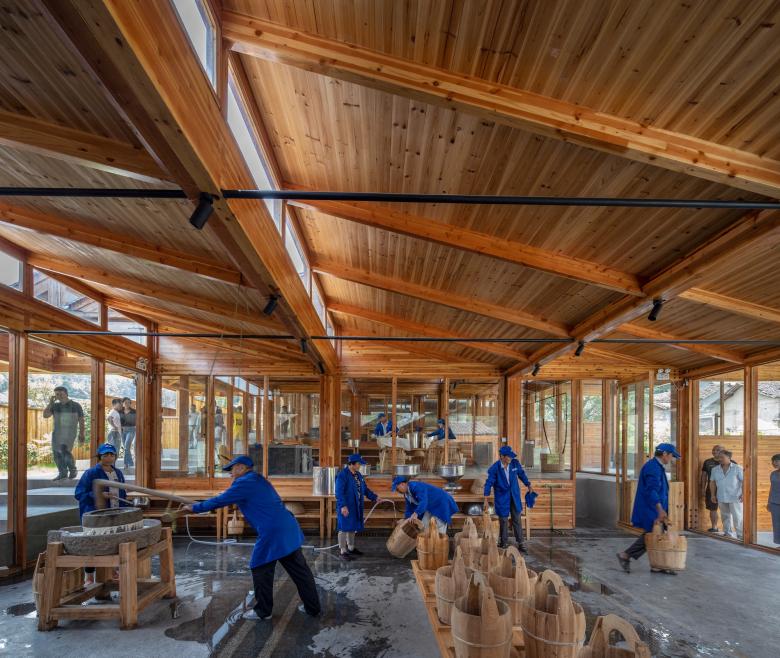
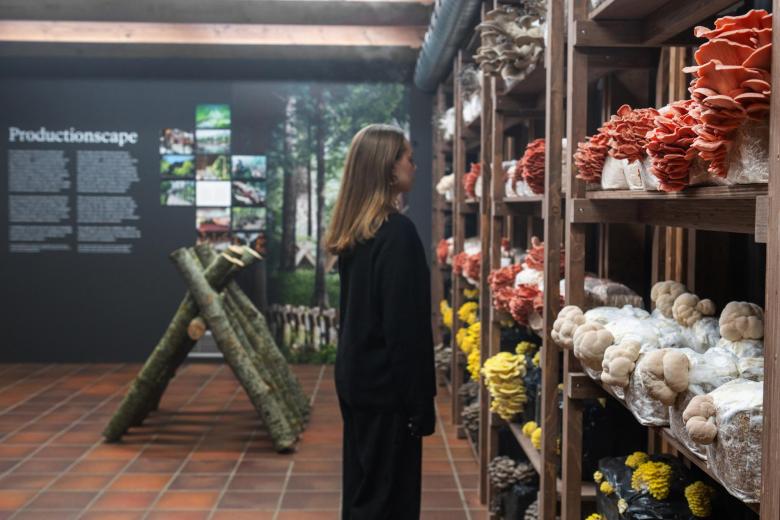
Under the heading Productionscape, the exhibition presents DnA’s utilitarian buildings in Songyang, including the Brown Sugar Factory, the Tofu Factory, and the Mushroom Community Center in Qingyuan County, all located in Zhejiang Province. Regarding the last, the production of mushrooms was translated into an impressive, walk-in experiential space within the exhibition. Here, a humid climate is maintained to support the optimal growth of edible mushrooms. These are cultivated, harvested, and processed by the local restaurant above the exhibition space, allowing visitors to actually taste-test the results in the restaurant following the visual and physical experience of the exhibition.
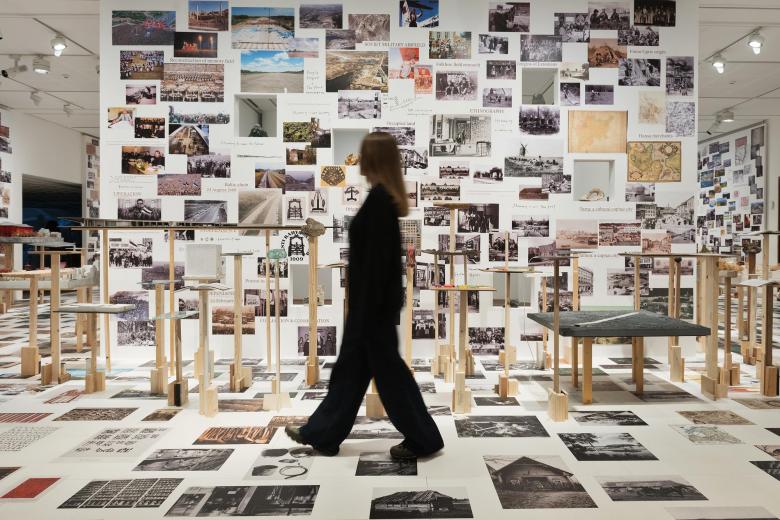
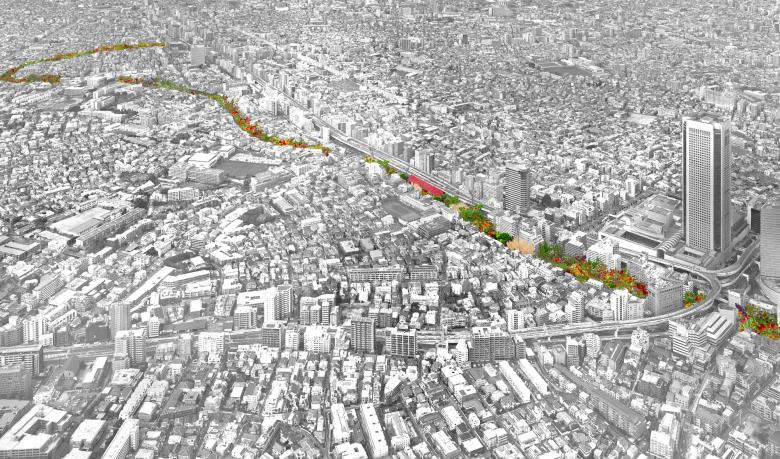
Tsuyoshi Tane describes his method as an Archaeology of the Future, through which he investigates historical fragments and, in a complex process, assembles them into a new narrative that draws on memories, materials, experiences, and artifacts long since vanished. The exhibition presents both very large and quite small projects by ATTA, whose potential is grounded, via his method, in historical materials and the stories embedded in each site. One project on an urban scale is the linear park 388Farm, in which the reconstruction of a 2.6-kilometer-long water supply system from seventeenth-century Tokyo is transformed into a cultivated green strip. This intervention creates a new connection to nature for the surrounding neighborhoods.
The Imperial Hotel in Tokyo, built in 1923, was Frank Lloyd Wright’s most celebrated work in Japan. In 1970, it was unsentimentally replaced by a crude hotel block. After winning a competition, ATTA reconceived this structure as a high-rise, drawing on ornaments and formal expressions from Wright’s original design. Tane’s intention, however, is not to imitate historical precedents, but to sustain the continuity of a genius loci nourished by remembered stories and images embedded in the collective memory.
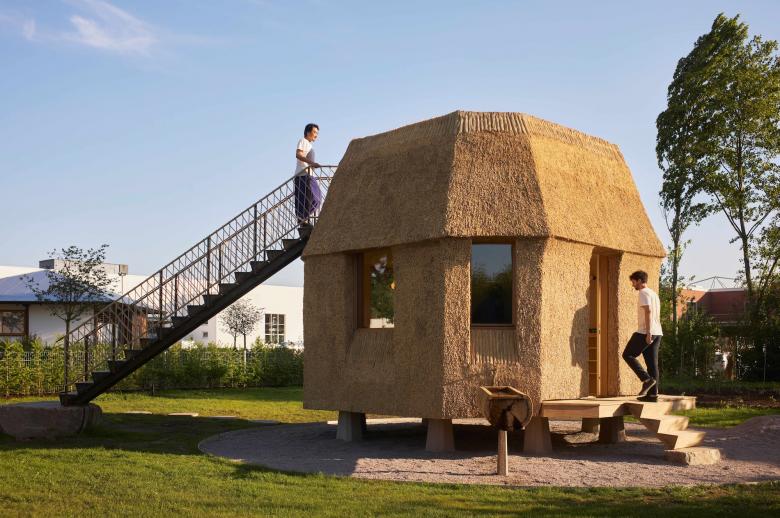
The Swiss company Vitra, based in Weil am Rhein, invited Tane to design a small folly for the Oudolf Gardens, which opened in 2020. The pavilion joins a collection of iconic buildings by renowned architects, and Tane likewise sought an individual design that would honor both the site and its use. To this end, he excavated stories and images of garden pavilions ranging from ancient Egypt through the Middle Ages to the modern era, studied the region’s vernacular architecture, and produced more than one hundred models before arriving at the final design. The structure was realized using sustainable materials sourced as locally as possible, in a performative process involving local craftspeople. Its core is made of wood and is precisely clad in thatch. A lookout on the roof is accessed by a stairway, whose railing is secured with ropes.
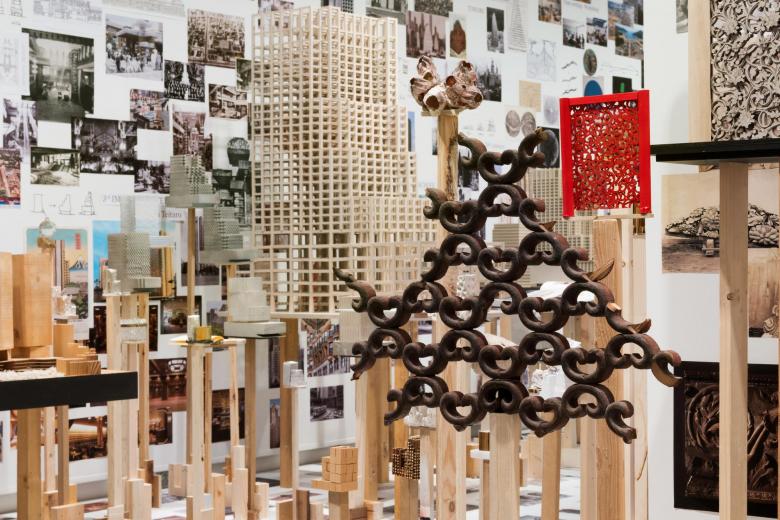
Through a dense collage of images, models, and found objects that cover both the floor and the walls of the exhibition space, Tsuyoshi Tane strikingly presents his working method. His approach legitimizes the use of memories, ornaments, and fragments charged with historical references, which—through innovative recombination—are intended to respond to the needs of the future.
In her projects on display, Xu Tiantian creates new experiential spaces derived from traditional contexts. These spaces support local agricultural production while simultaneously strengthening socio-cultural identification with place. Through point-based stimulation—analogous to acupuncture—she succeeds in renewing socio-economic and cultural practices, with architecture playing a central and sustaining role in this process.
The two concepts presented in the exhibition, both aimed at improving local living conditions beyond the architectural object, may also be understood as evidence that there is no place without stories—stories that keep a sense of home alive for its users. In both cases, emotional attachment is reinforced through architecture, which becomes part of a continuum and enters a cycle of memory and imagination. The Louisiana Museum of Modern Art—so perfectly integrated into its surrounding landscape, and the venue for the Memoryscapes exhibition—almost appears as another exhibit in and of itself, embodying precisely the attitude shared by the two architects.