Architect Yan Meng from the Beijing- and Shenzhen-based firm URBANUS has designed two schools in Shenzhen that make direct reference to the local architecture of the Hakka people. Although the Hakka are not an ethnic minority, their history has led them to develop a distinctive architectural culture, one that is gradually being erased by the urbanization of recent decades.
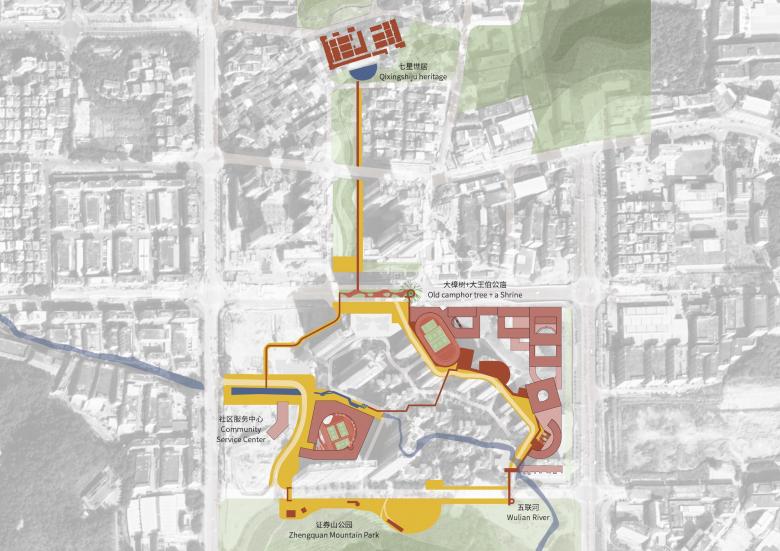
Over centuries, the Hakka migrated to already settled areas in southern China and built fortified villages in round or square forms for their clans to better defend themselves, if necessary. Today, many of the buildings stand unused, others are falling into disrepair, and some are being preserved as historical relics. Disappearing with these old buildings is the distinctive spatial concept that determined the monolithic architectural form – that of individual spaces surrounding communal courtyards. Yan Meng drew on this concept to create a contemporary architectural form for the young community in the schools. One such historic Hakka village complex, Qixing Shiju, is located just a few hundred meters north of the new schools and includes a semicircular pond in front of the main southern entrance.
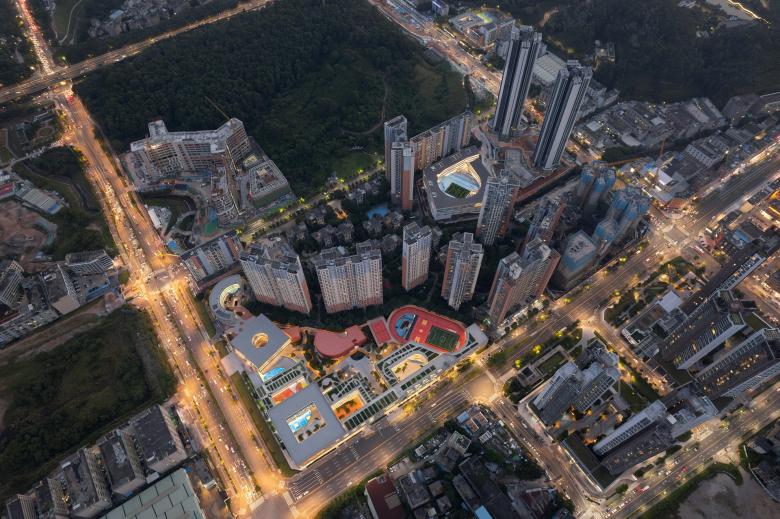
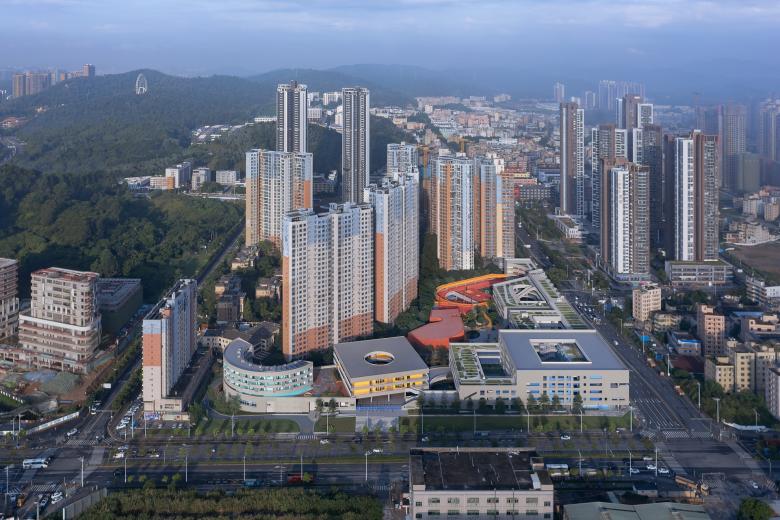
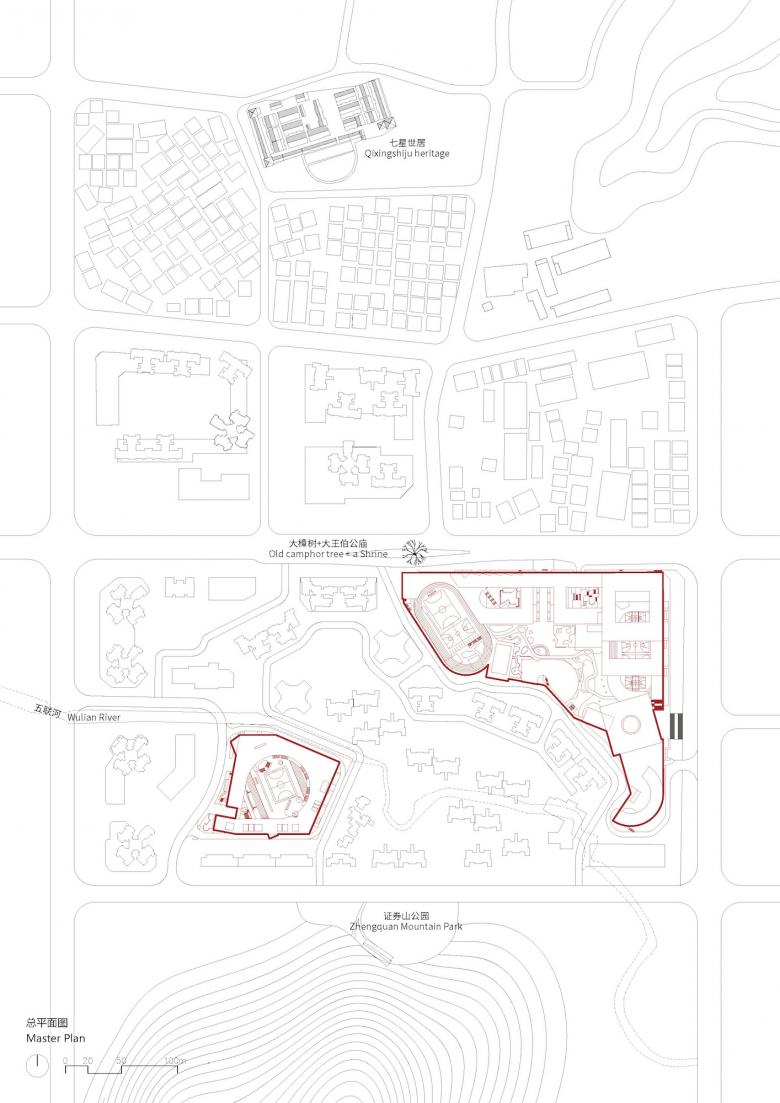
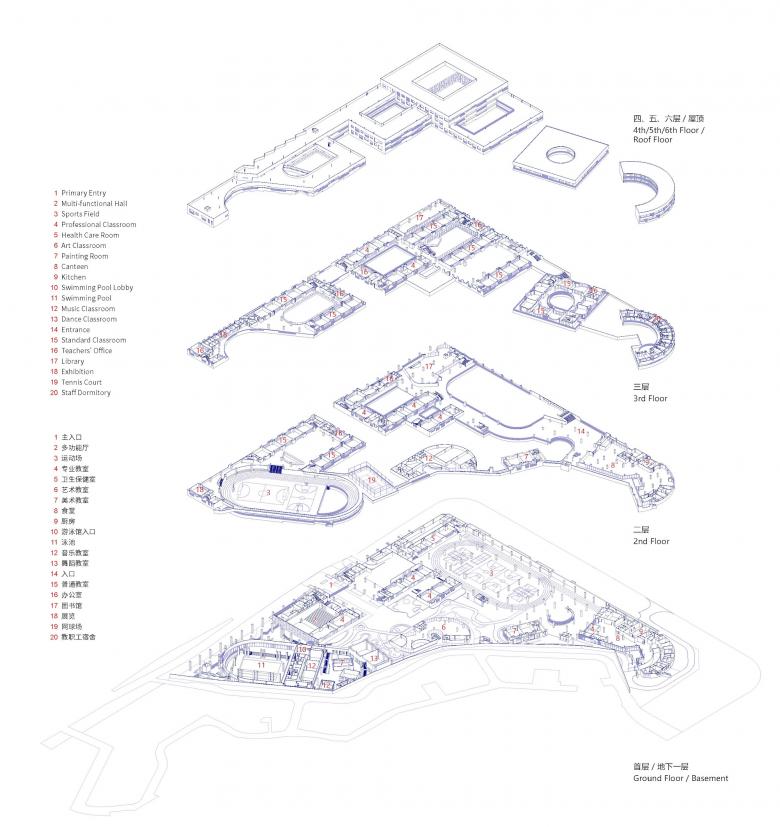
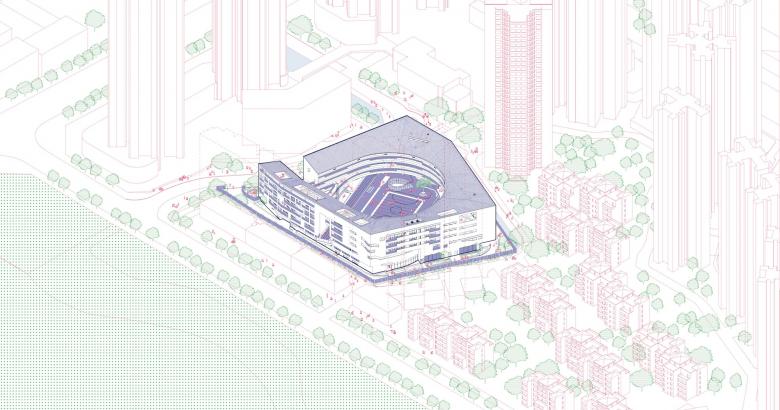
The two schools are located in a heterogeneous urban block, occupied by five-story residential buildings and high-rise apartment buildings up to 50 stories tall, and bordered by Zhengquan Mountain Park to the south. A site (Weilong School) on the corner of two major city streets in the northeast of the block and an undeveloped infill site (Wuwei School) in the southwest were reserved for the schools. The Wulian watercourse flows from the mountain park through the grounds of the southern site.
The multi-layered courtyard areas typical of Hakka buildings inspired the architects to integrate this spatial logic into the spatial ensembles on both sites as a device to define a collective space among the anonymous high-rise clusters for the newly formed school communities of students, teachers, and parents. With up to five above-ground stories, the Weilong School buildings match the scale of the of adjacent homogeneous urban blocks, in terms of height: residential buildings, including informally built neighborhoods, range between five and eight stories. On the northern side of the block, an old camphor tree and a shrine have been preserved, giving the place a little character of its own.
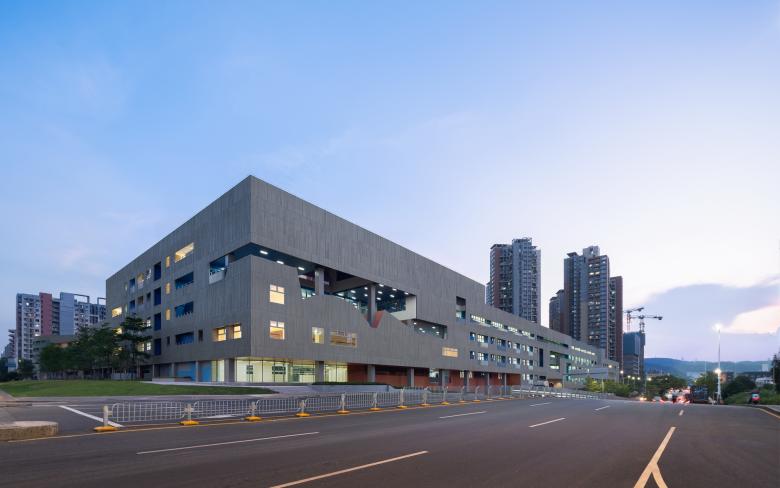
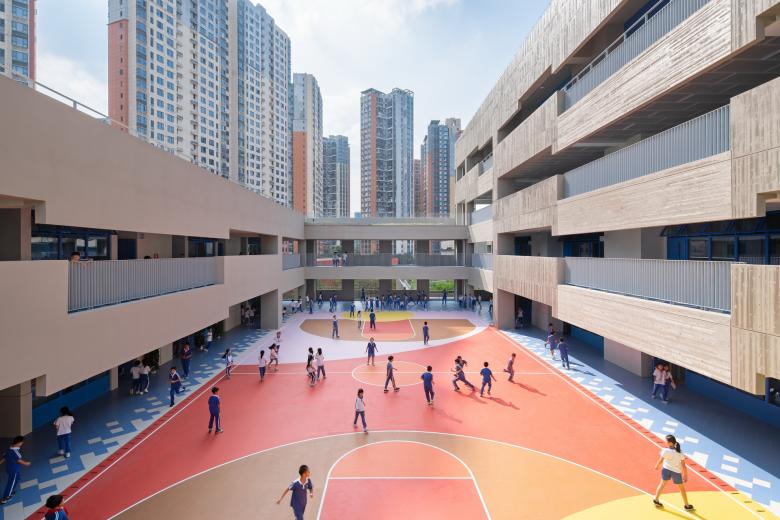
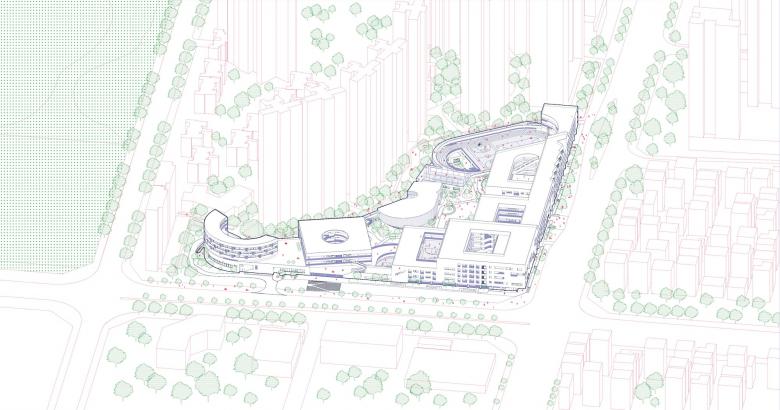
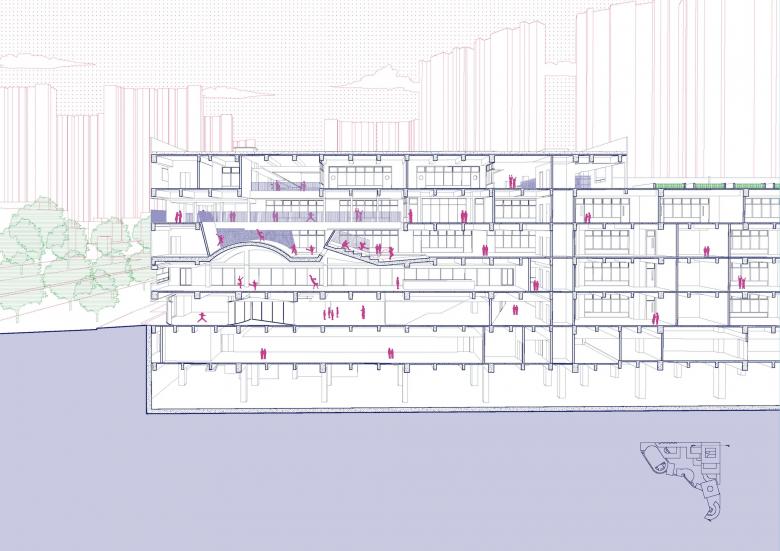
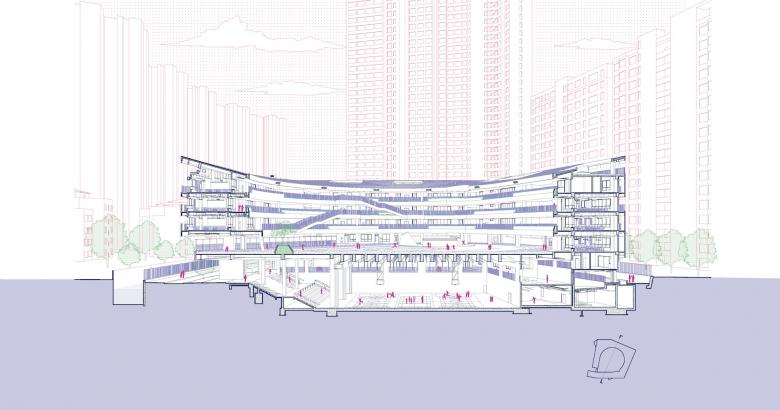
The architecture of the Weilong School echoes the horizontal character of Hakka buildings, thus counterbalancing the oversized, 30-story vertical surroundings. The school buildings are concentrated along the street edges in evenly layered volumes that open onto the interior spaces, where landscaped courtyards form individual niches.
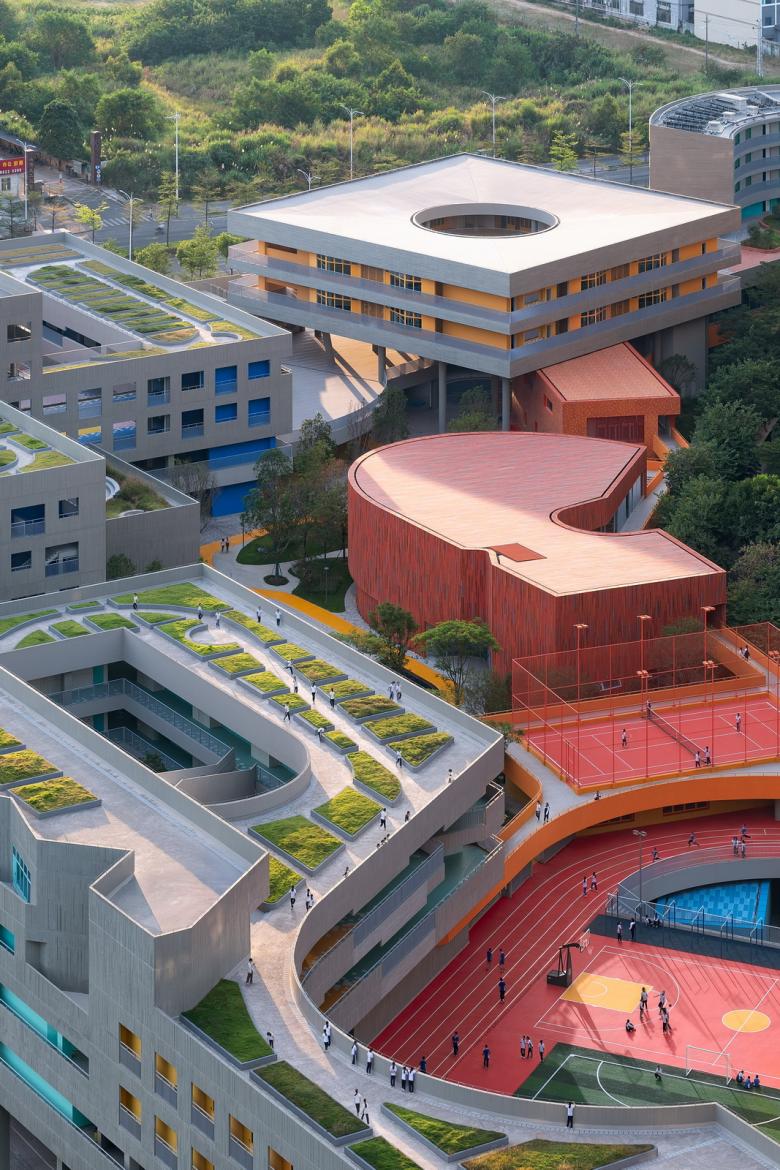
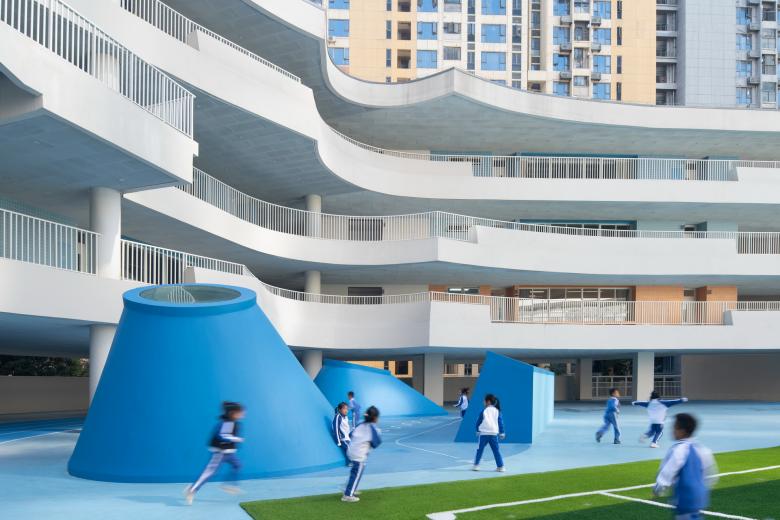
Facing the streets an arcade is integrated into the ground floor, mediating between the urban environment and the school. From here, corridors lead into the school complex. The functionally divided school units for different learning levels each have access to the internal courtyard system. For the younger children, circular ramps and passageways that invite free movement. While the building volume appears calm and regular from the outside, the interior features a variety of shapes, colors, and spatial connections that create a vibrant urban space within the school.
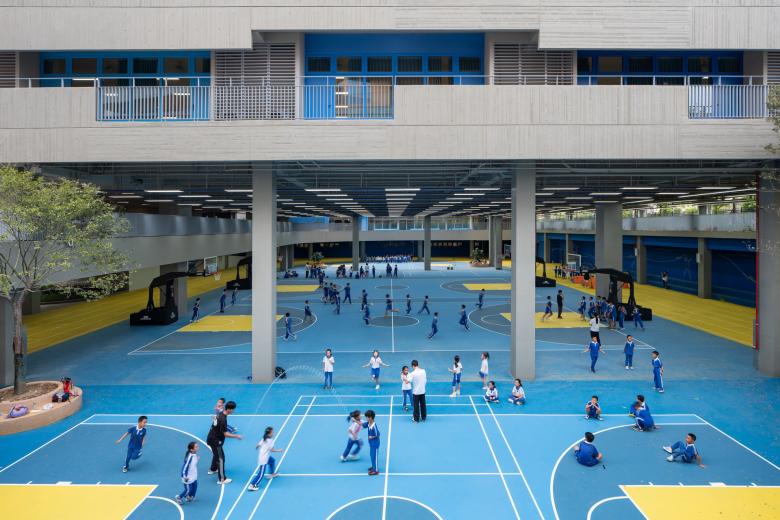
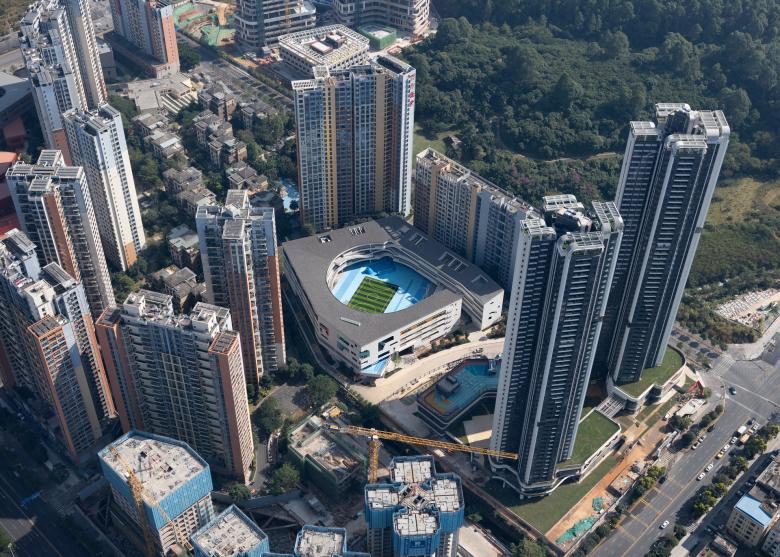
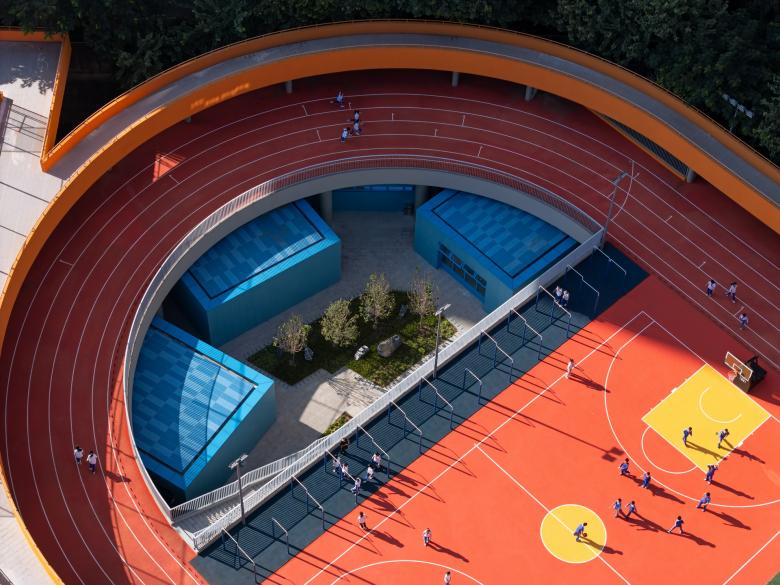
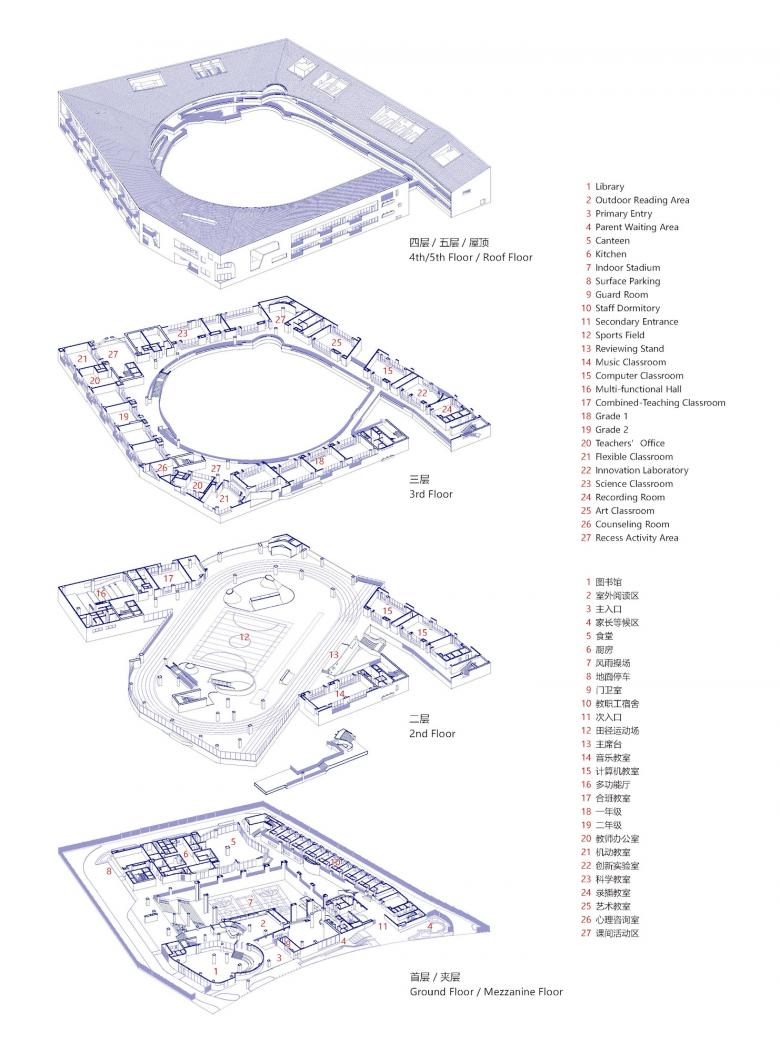
The Wuwei School site is irregularly polygonal and surrounded by towers up to 50 stories high. The outer shape of the building follows the polygonal layout of the site, while the oval, teardrop-shaped courtyard with a sports field on the first floor covers the entire area. The ground floor houses communal cultural and sports facilities. The large central sports field serves as a stage for important community events, thus strengthening cohesion in the neighborhood.
In addition to traditional Hakka culture, the climate and functional requirements of the school were decisive factors in the design. The architecture responds to the monofunctional environment and, with the courtyard, provides it with a central spatial element with which students and residents can identify.
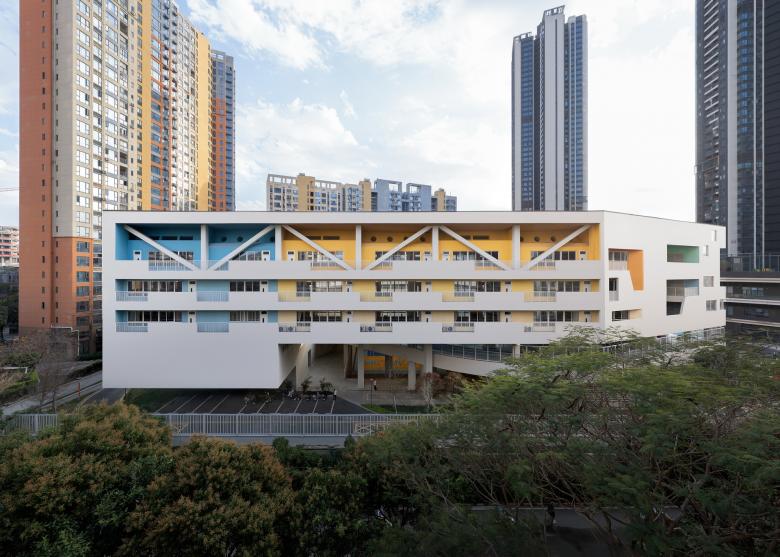
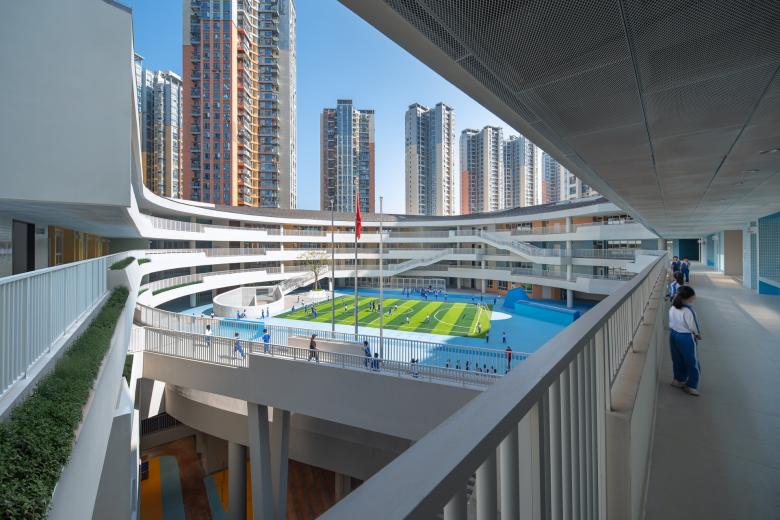
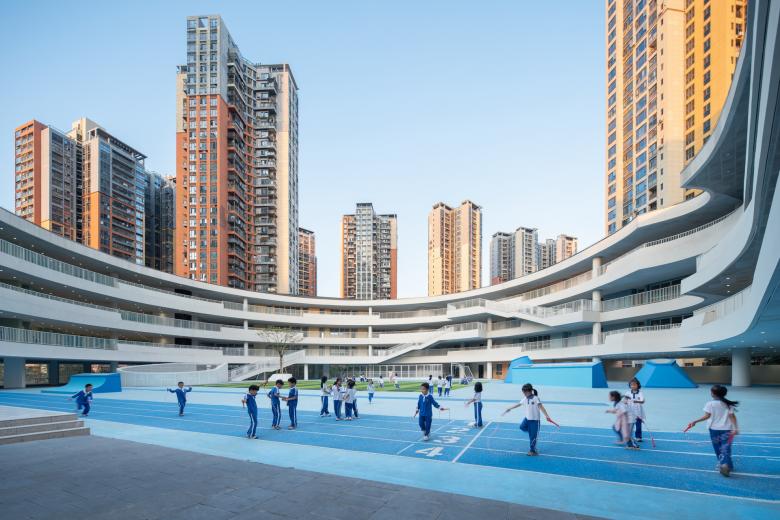
By drawing on the almost forgotten culture of the Hakka, the architects attempt to place the oversized residential structures in a more human-scaled context by offering schools as spaces of identification that enable both children and adults to form an emotional connection. The large structures blend organically into the heterogeneous building sites. Creative layering and free placement have resulted in two ensembles which, with up to seven stories (two underground), form a multifaceted counterweight to the simple residential towers in the direct neighborhood. The heterogeneous open spaces, which are often connected across several levels, form an architectural landscape that blurs the distinction between urban structures and individual architectural objects. With the two schools, the architects have succeeded in designing an urban ensemble that compensates for the deficits of the neighborhood and remains with its reference to the Hakka culture recognizable in the local context of the megalopolis of Shenzhen.
Text by Eduard Kögel.
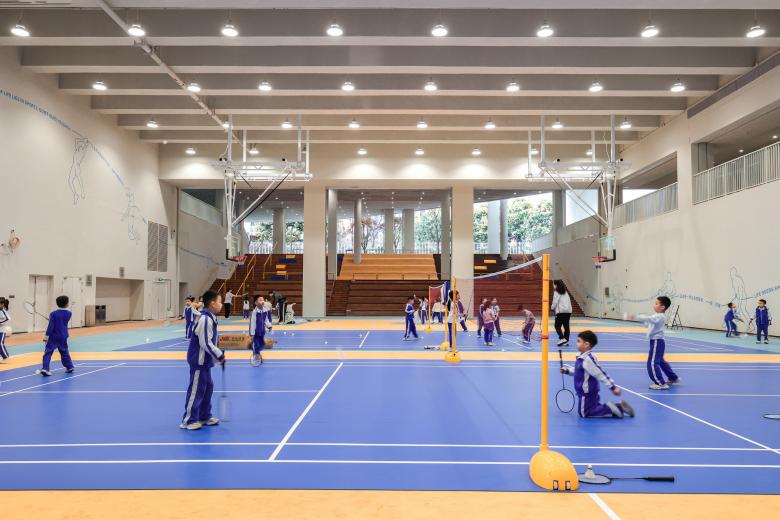
Location: Wulian Community, Longgang District, Shenzhen, China
Client: Public Works Bureau of Longgang District, Shenzhen
Architect: URBANUS
- Principal Architects: Meng Yan, Wen Ting
- Competition (Pre-qualification) Team: Sun Pengcheng, Huang Jiahong, Zhang Chaoxian
- Competition Team: Huang Jiahong, Zhang Chaoxian, Zeng Yi, Yu Shiyao, Zhu Hongrui, Liao Guotong, Weng Hua, Zhou Yuerong, Gao Yunrui, Song Baolin, Sun Jiawei, Chen Jing | Gong Yidan (Community Building) | Ma Xiying, Pu Jinyan (landscape) | Chen Yining, Zhang Hui, Zhang Xinyu (Internship)
- Project General Manager (Weilong School): Zhang Haijun
- Project Manager (Weilong School): Zeng Yi
- Team (Weilong School): Zhu Hongrui, Gao Yunrui, Chen Jing, Dong Wenhan | Yao Xiaowei (Technical Director) | Zhang Xuejuan, Gao Yufeng, Li Guanda, Ma Xiying, Pu Jinyan, Wang Tingxin (Landscape) | Deng Tingfang, He Yutong, He Jiamin (Interior) | Liao Fuhua, Xu Zhihao, Tan Yongxian (Internship) | Gong Yidan, Coming Home Enterprises & Xiangtian Chuangwen (Community Building)
- Project Manager, Project Architect (Weiwu School): Weng Hua
- Team (Weiwu School): Zhang Chaoxian, Zhang yingyuan, Huang Jiahong, Liao Guotong (Architecture) | Zhang Xuejuan, Li Guanda, Wang Tingxin, Gao Yufeng (Landscape) | He Jiamin, Deng Tingfang (Interior) | Zhang Hui, Li Peiying, Guo Anran, Hu Xiaomai, Huang Xianwen, Zhang Yipei, Tan Yongxian (Internship) | Gong Yidan, Coming Home Enterprises & Xiangtian Chuangwen (Community Building)
- Technical Director (Weiwu School): Yao Xiaowei
Weilong School:
Site Area: 31,567 m²
Floor Area: 73,511 m²
Floors: 5 Floors above-ground, 1 Floor underground
Building Height: 24.0 m
Structural Type: Frame Structure
Building Materials: Fair-Faced Concrete, Coating, Ceramic bricks, Ceramic rods, Ceramic panels, Fiber Cement Board, Aluminum Expanded Metal Ceiling
Collaborators:
- Structural Consultant: H&J International Co., Ltd.
- (CD) Structure/ MEP (Construction Document): Shenzhen Architecture Design General Research Institute (SZAD)
- Interior Development: Nan Jing Shang Ze Design Co., Ltd.
- Landscape Development: Shenzhen Sen Shi Jie Landscape and Planning Co., Ltd.
- Acoustic Consultant: Shenzhen KEDE Co., Ltd.
- BIM: Shenzhen Qianhai Future City Technology Co., Ltd.
- Kitchen Consultant: Anda Kitchen Design Co., Ltd
- Green Building: Shenzhen Zhong Ji Green Building Co., Ltd.
- Graphic Design: SURE Design
- Contractor: Guangdong Lianfu Construction Engineering Co., Ltd
- Concrete Construction: Wuhan Wanshan Qingshui Construction Engineering Co., Ltd
- Interior and Landscape Construction: Shi Dai Zhuang Shi Co., Ltd
- Construction Agency: China Resources (Shenzhen) Co., Ltd.
Weiwu School:
Site Area: 10,115.3 m²
Floor Area: 25,836 m²
Floors: 5 Floors above-ground, 1 Floor underground
Building Height: 25.5 m
Structural Type: Large-Span Cantilever Steel Structure + Concrete Frame Structure
Building Materials: Concrete, Coating, Cement Tile, Mosaic Tile, Aluminum Expanded Metal Ceiling
Collaborators:
- Structural Consultant: H&J International Co., Ltd.
- (CD) Structure/ MEP (Construction Document): Shenzhen TIANHUA Architectural Design Co., Ltd.
- Landscape Development: Shenzhen Paier Landscape Planning and Design Consulting Co., Ltd.
- Interior Development: JNJW Architectural Design
- Graphic Design: SURE Design
- Contractor: China Construction Fourth Engineering Division Corp. Ltd.
- Construction Agency: Shenzhen Vanke City Construction Management Co., Ltd.
Related articles
-
-
-
Gymnasium of South University of Science and Technology
Urbanus Architecture & Design | 07.12.2021 -